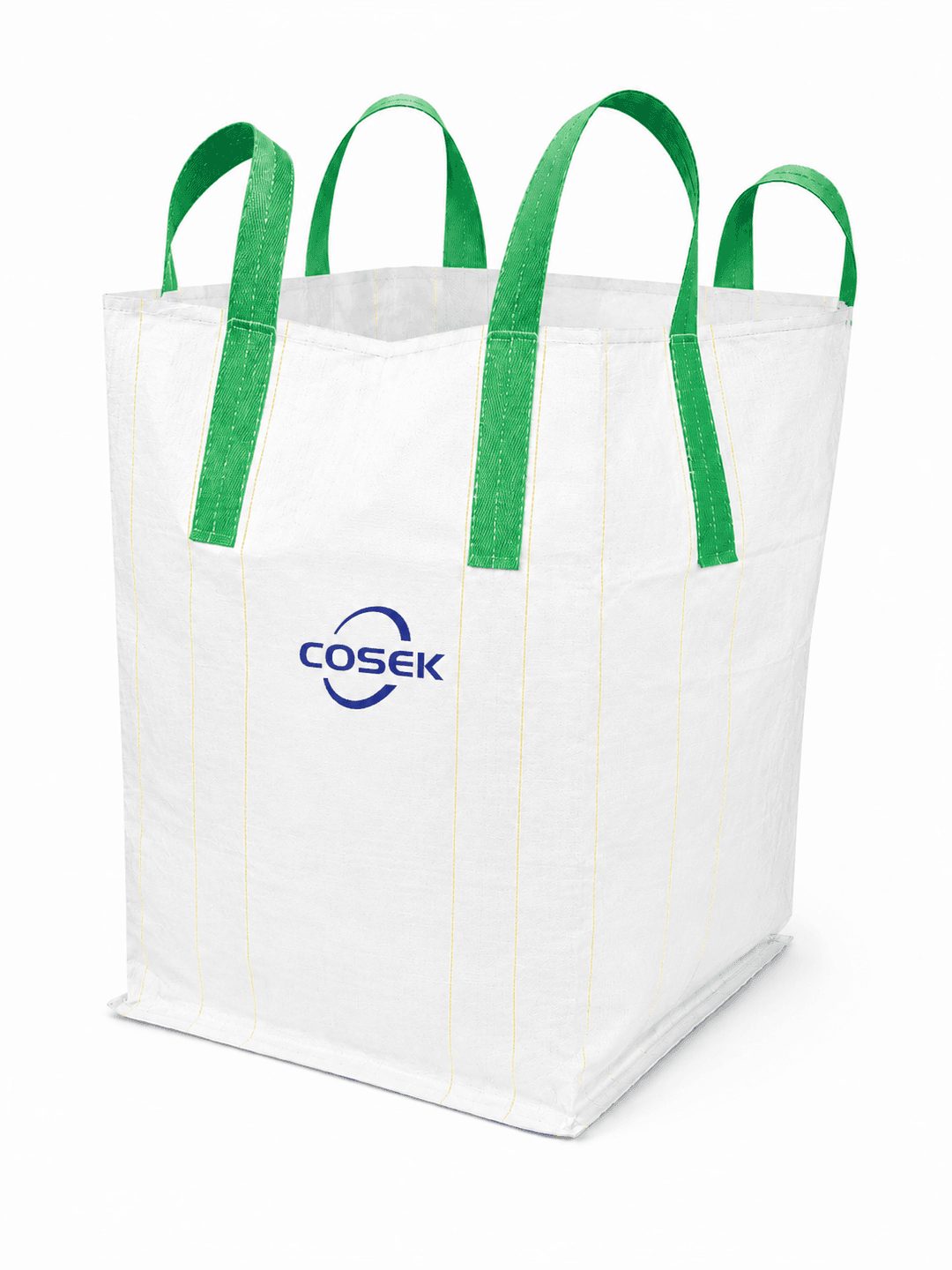
American material handlers say super sack, bulk bag or tote, and whichever word they use they are usually describing a circular FIBC — the tubular weave that fills fast, discharges clean and costs less per unit than any alternative that passes a 5:1 test. Walking through where circular construction wins in US operations, and where it honestly does not, is more useful than any catalogue.
Resin, plastics and pellets
The resin sector is the volume heart of the US bulk bag market. Pellets flow, which is exactly what circular construction is for: the round bag fills fast on automated lines, discharges almost completely through the spout, and the lack of side seams removes the sifting point where fines escape in a warehouse of clean-room-minded processors. Typical spec: 90 x 90 x 110 cm, 1,000 kg SWL, uncoated fabric with an antistatic option where the handling zone demands it — Type C where lines are disciplined about grounding, Type D where they are not. Resin buyers also drive the cleanest print standards in the trade, and in-line flexo handles their four-colour brand requirements without fuss.
Agriculture, seed and feed
Seed conditioners, feed mills and peanut and rice operations move product in bulk bags year-round. The specification conversation here is about contamination and moisture: food-contact liners where the cargo chain demands the relevant FDA-referenced declarations, ventilated panels where the product must breathe, and sift-proof seam treatment where dust control matters. Seed lots also get lot-number print for traceability, which the in-line printer handles as part of the standard run rather than as an after-process.
Construction, landscaping and aggregates
Sand, gravel, mulch and stone move in one-tonne bags to job sites where a forklift does in minutes what shovels do in hours. The failure mode in this trade is base wear from yard dragging, so the spec runs a heavier base panel and reinforced lifting zones; coated fabric keeps rain out of a load sitting on an open site for a week. Discharge is usually a full skirt rather than a narrow spout because crews cut the base and let gravity do the rest — and the bag design should assume that, not fight it.
Where circular is the wrong answer
Cohesive powders that arch and bridge, cargo needing flat walls for two-high stacking, and applications where the bag must present a flat face for palletisation all point to U-panel construction with baffles. Saying so costs us the occasional upgrade sale and earns the reorder that matters. The right construction for the cargo is the whole game in bulk packaging.
Frequently Asked Questions
What is the standard US super sack spec?
35 x 35 x 43 inch, 2,000 lb SWL at 5:1, uncoated polypropylene, four loops, fill spout and discharge spout — the configuration most US filling lines are built around.
Do you supply food-contact liners for US food operations?
Yes, liners ship with the relevant food-contact declarations, and migration test documentation is available per liner lot for buyers who audit their packaging chain.
Antistatic — Type C or Type D for my line?
Type C if your team grounds every bag reliably; Type D if human error is the risk you are engineering out. Both are produced and tested to the relevant IEC references.
What does the import timeline look like?
About three weeks production plus 24 to 32 days ocean to US ports depending on coast, so plan five to eight weeks from purchase order to warehouse.
Full spec range is on the Circular FIBC Bag page. For the price structure read the FIBC bulk bag price guide for US distributors, and for the liner detail see FIBC liners: form-fit, tubular and food-grade options.