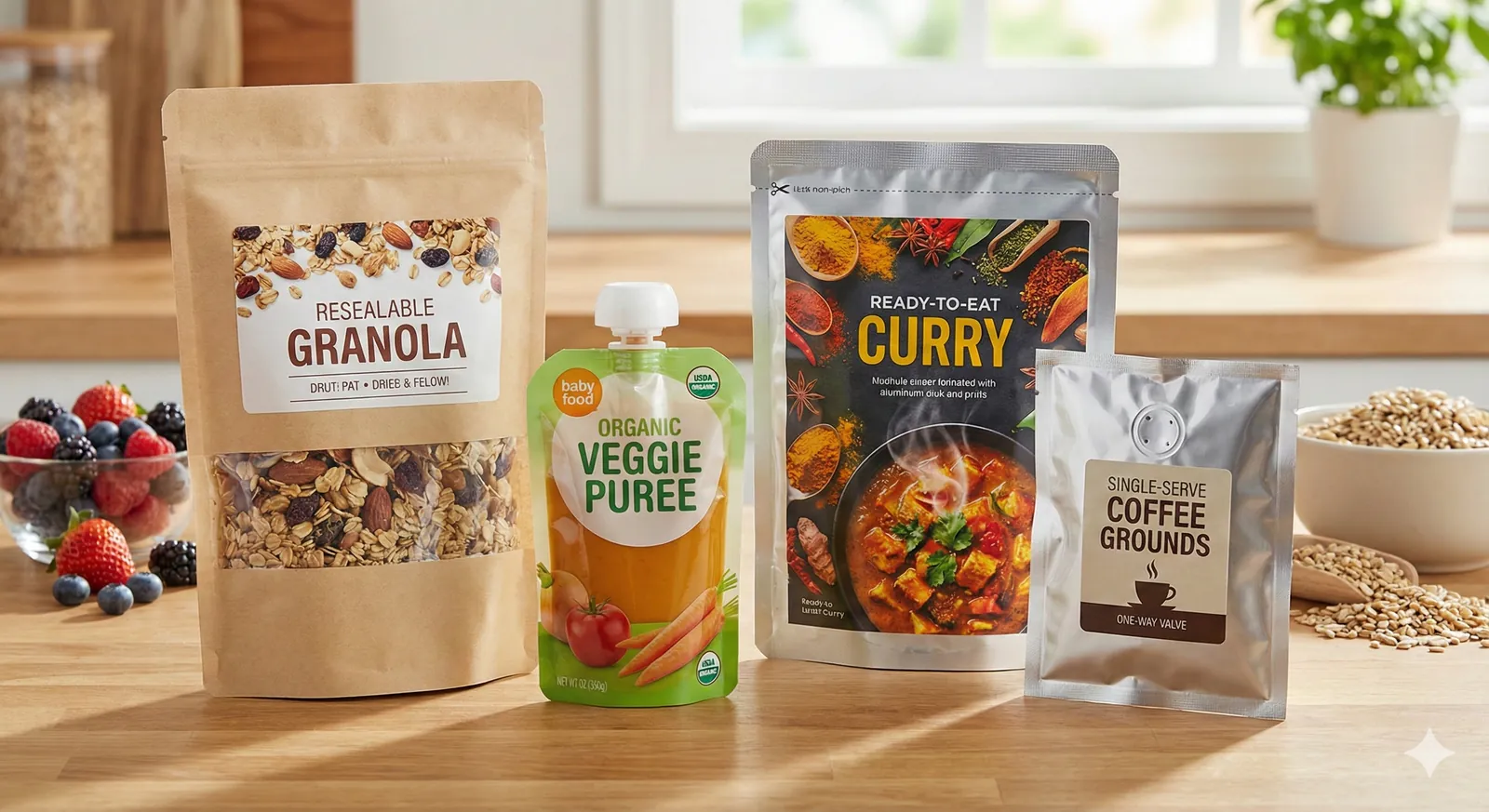
Shelf life is a structure, not a promise. Coffee that tastes like the roastery's intention, spices that keep their volatiles, protein powders that survive a warehouse summer: all of that lives in the lamination layers of a pouch. We produce multilayer food-grade pouches for US brands and private labels, and the specification conversation always starts the same way: what does your product fear? Oxygen, moisture, light, aroma loss? The answer picks the structure, and the structure picks the price.
Barrier structures, mapped to products
| Structure (outside to inside) | Barrier strength | Typical products |
|---|---|---|
| PET / PE | Basic | Baked snacks, dry mixes, short shelf life |
| MAT-PET / MPET / PE | High | Coffee, nuts, protein, premium snacks |
| PET / AL foil / PE | Near-total | Specialty coffee, pharma, long-storage goods |
| PET / PE with EVOH coex | Oxygen-focused | Sauces, retort-adjacent applications |
The middle layer does the barrier work; the PE food-contact layer seals; the outside layer carries print. Vacuum metallized PET delivers most of foil's oxygen barrier at lower cost, which is why it dominates mid-premium work, while true foil remains the answer for products measured in years, not months.
Formats US brands run
Three-side seal sachets for single-serve, stand-up pouches with bottom gusset for shelf presence, side-gusset for coffee, spouted pouches for liquids and purees. Zippers and tear notches are standard add-ons rather than exotic features. Pouch sizes run from sample sachets to multi-kilogram bulk formats, and everything ships flat, which is the format's quiet logistics advantage over rigid packaging.
Compliance is layer-level, not label-level
The food-contact layer should be virgin PE compliant with FDA 21 CFR 177.1520 (or the applicable regulation for the resin), produced with documented food-safety handling, with migration data available for your product category. We supply lot certificates and structure declarations as standard paperwork. If a prospective supplier cannot name the regulation on their food-contact layer, the price conversation is happening at the wrong depth.
Indicative pricing and order mechanics
Finished pouches run roughly $0.05 to $0.15 each FOB India depending on size, structure and print coverage, with foil and specialty structures above that band. Gravure printing up to 10 colors; cylinders are one-time and stay on file for repeats. Minimums follow one production run per design, and pre-production printed samples ship by air for sign-off before the run. Production is 3 to 4 weeks; ocean 4 to 6 weeks East Coast; pouches ship flat so container cube works in your favor.
Brand team questions
Can you match our incumbent pouch exactly?
Send us the used pouch, we read the structure, gauge and seal configuration, and quote a like-for-like with test results. Switching suppliers should be a blind comparison, not a bet.
What about digital print for short runs?
For seasonal and limited SKUs, digital short runs exist and we will point you to the right process; gravure is the economic answer once a design is steady.
Structures and formats are on the Multilayer Food Grade Pouches page. For reclosable retail formats see zipper pouches, and for film-only supply the printed BOPP rolls guide.