British buyers discovered liners the practical way — a flour miller with a clumped load, a chemical packer with a moisture claim — and now the liner question appears in most serious UK bulk-bag quotations. The specification conversation has two parts: which liner for which cargo, and what documentation the cargo chain requires, which after Brexit means the GB food-contact regime for food cargo. Here is both, from the supplier side.
Which liner for which cargo
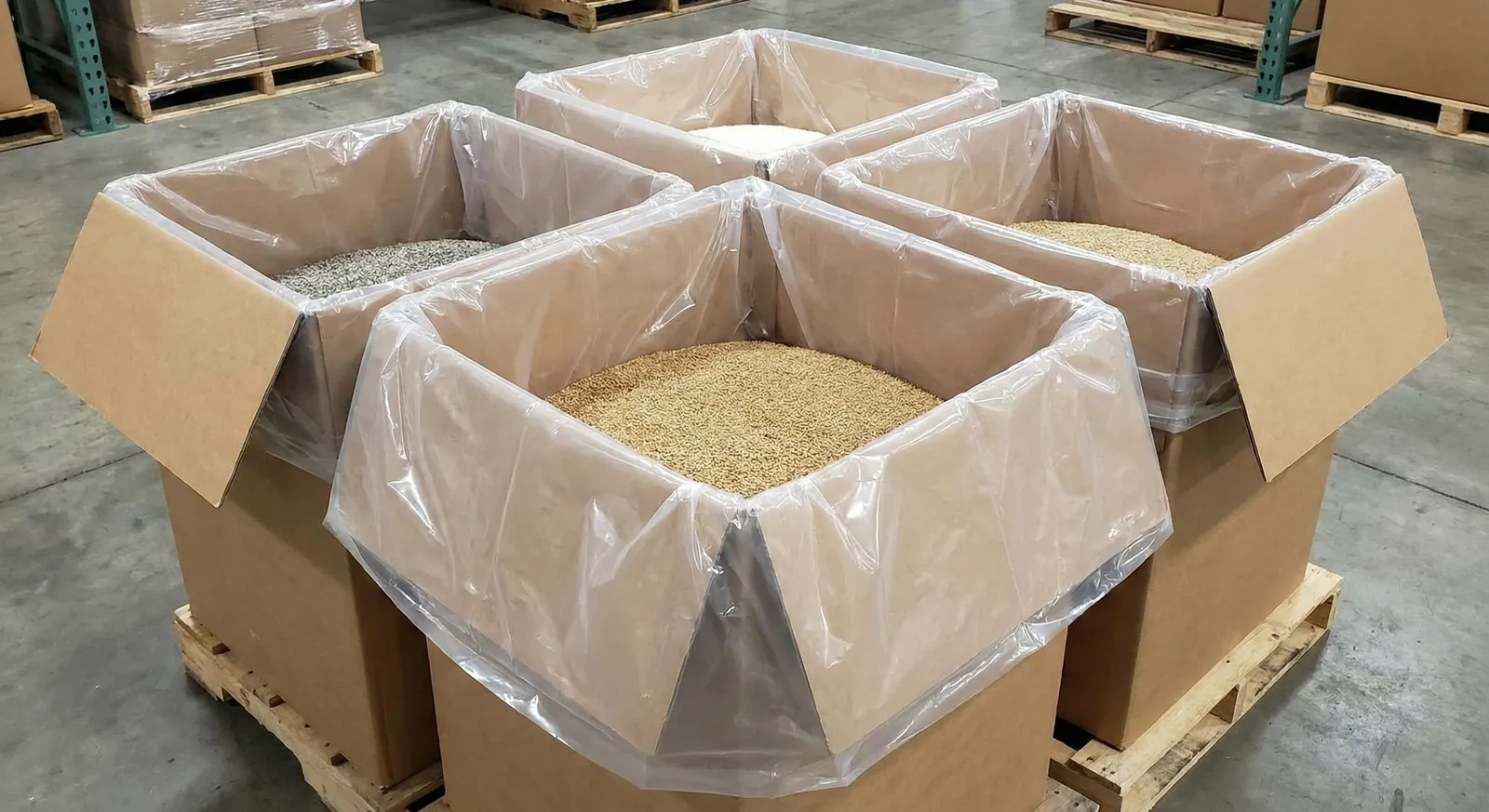
Tubular liners — the economical LDPE or LLDPE sleeve — handle granules and pellets where wall-fit is a nicety, not a requirement. Form-fit liners, shaped and sealed to follow the bag's corners, are the powder answer: product does not trap in film folds, discharge runs clean, and the filling line does not fight loose film. Barrier liners — coextruded EVOH or aluminium foil constructions — block moisture, oxygen and odour for cargo with contractual shelf or purity specs. Thickness runs 50 to 125 micron: 75 to 100 for powder duty where the film survives line handling and discharge abrasion, 50 to 75 for granules. Anti-static treated and conductive liner options cover static-prone powders, and bottom-discharge liners mate with the bag's spout for lines that must empty completely.
Food-contact documentation in the GB regime
Food cargo in Great Britain moves under the retained food-contact framework — the GB rules carried over from EU law, maintained separately since. The practical artefact is the same discipline as before: a declaration from the liner manufacturer naming the material, the authorised substances and the conditions of use, backed by migration test availability. Our food-grade liners ship with that documentation per lot, and British food QA teams — flour, sugar, dairy powder, ingredient blending — file it into their supplier-audit chain once. For chemical cargo the same documentary discipline covers the anti-static and barrier constructions, which is what a COSHH-conscious buying team expects when they ask what the liner actually is.
Factory-fitted supply from India
Fitting quality decides whether a liner does its job, so we fit at the plant: inserted, form-fit shaped where specified, top-closed, then baled — the bag arrives filling-line-ready with the operator-error variable removed. MOQ for lined bags starts at 1,000 pieces, production about three weeks, ocean transit 18 to 24 days to Felixstowe, London Gateway or Southampton. Duty follows the same low single-digit band as the bag family under the UK Global Tariff — your broker confirms the line — and every batch ships with the test reports, declarations and retained samples that make year three of the contract as calm as the first container.
Frequently Asked Questions
Do your food liners satisfy GB food-contact requirements?
Yes, declarations per lot under the retained GB framework, naming material, authorised substances and conditions of use, with migration documentation available.
Form-fit or tubular for a flour miller?
Form-fit at 75 to 100 micron — complete discharge, no product trapped in folds, and a film that survives the filling line.
Can liners be factory-fitted before shipping?
Yes, all liner types are fitted and closed before baling so bags arrive filling-line-ready.
What is the MOQ and lead time?
1,000 pieces for lined bags, five to six weeks from purchase order to UK port on a new order.
Liner options are on the FIBC Liners page. For the UK bag import picture read importing PP jumbo bags from India to the UK, and for the moisture-barrier science see why PE liners are the moisture barrier that matters.