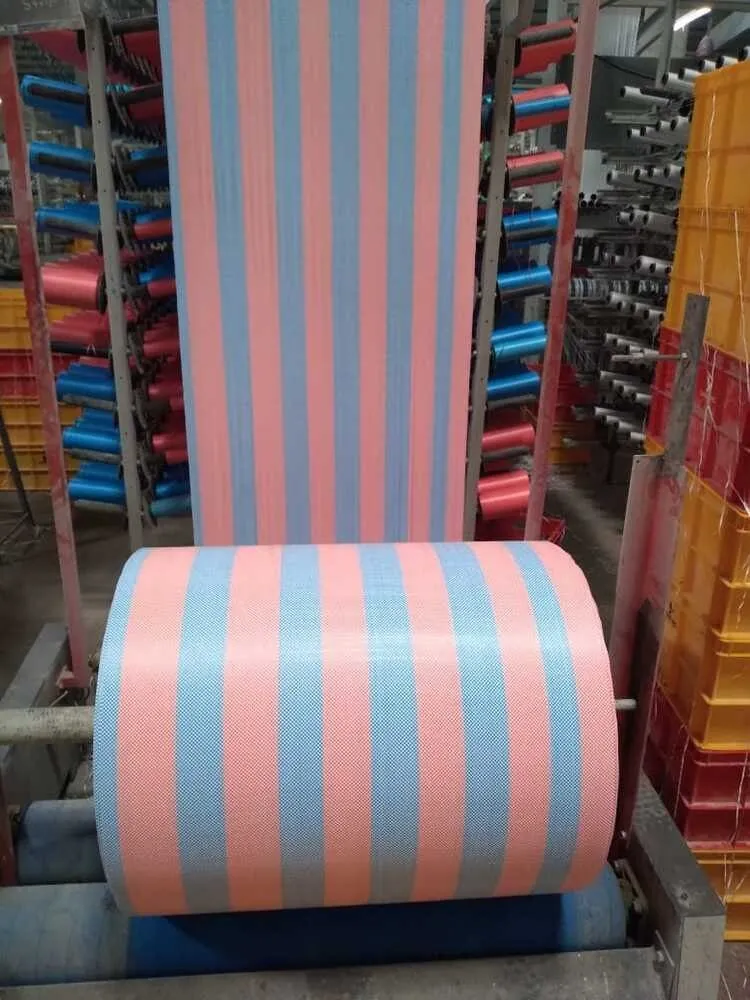
Circular bulk bags get ordered more often than they get specified. Many US buyers ask for a circular bag because the last supplier shipped circular bags, without knowing why that construction suits their material. The short version: a circular FIBC is woven on a circular loom into a continuous tube, so the body has no side seams. Fewer seams mean fewer places for fine powder to sift out and fewer stress points when the bag hangs from a loader. Here is what a US buyer should actually pin down on the spec sheet.
Construction basics, in plain terms
The body is a seamless polypropylene tube, cut to height and closed at the bottom during stitching. Four lifting loops are sewn to the top corners. Because the tube is round, an empty circular bag looks slightly rounded at the corners when filled unless a baffle or a heavier fabric holds the shape. That is normal, not a defect, and it is one of the honest trade-offs against U-panel construction.
Where circular construction wins
- Free-flowing granules and resins: pellets fill the round body evenly and discharge cleanly.
- Sand, aggregates and minerals: no side seams means no sifting seams in the most stressed zone.
- High-lift, rough-yard handling: the tubular body distributes load around the circumference instead of concentrating it at corner seams.
For fine powders (titanium dioxide, pigments, flour-grade products) circular bags still work, but plan on a liner, because the weave itself is never sift-proof.
The spec lines to lock before you order
Capacity: most US buyers land between 35x35x43 and 36x36x50 inches at 2,000 to 3,000 lb SWL. Fabric: 160 to 200 GSM body is the working range; ask for UV stabilization if bags sit outdoors, which matters a lot in Texas, Florida and Arizona yards. Loops: 4 loops at 10 inch height is standard for forklift handling; request 12 inch or cross-corner loops if your loaders grab aggressively. Top: open top with skirt for drum-fill lines, fill spout for closed systems, or duffle top for manual filling. Bottom: flat bottom for single-trip, or a discharge spout with petal closure if you meter product out. Coating: a 25-30 micron poly coating on the inside face cuts moisture pickup and dusting, worth the small premium for most dry goods.
Indicative pricing and lead time
Standard circular bags in the 2,200 lb class run roughly $14.00 to $24.00 per bag FOB India depending on fabric weight and coating. A coated 200 GSM bag with a fill spout and discharge spout sits near the top of that range. Production is 3 to 4 weeks after artwork and deposit; ocean transit adds 4 to 6 weeks to the East Coast. Sample bags ship by air so your team can run a fill trial first.
Two questions we get weekly
Will a circular bag stand up straight when filled?
With granules and resins, yes, close enough to sleeve or stretch-wrap. If you need a true square face for high-density palletizing, that is the case for U-panel, not a reason to skip circular. We ship both and will tell you honestly which one your warehouse will thank you for.
Is circular cheaper than U-panel?
Usually by 5 to 10 percent at the same fabric weight, because there is no side-panel stitching labor. The gap narrows on coated or lined builds.
Full construction options and photos are on our Circular FIBC Bag page. If you are weighing the two constructions, our U-panel vs circular comparison lays out the trade-offs in one table, and the price guide covers landed cost math.