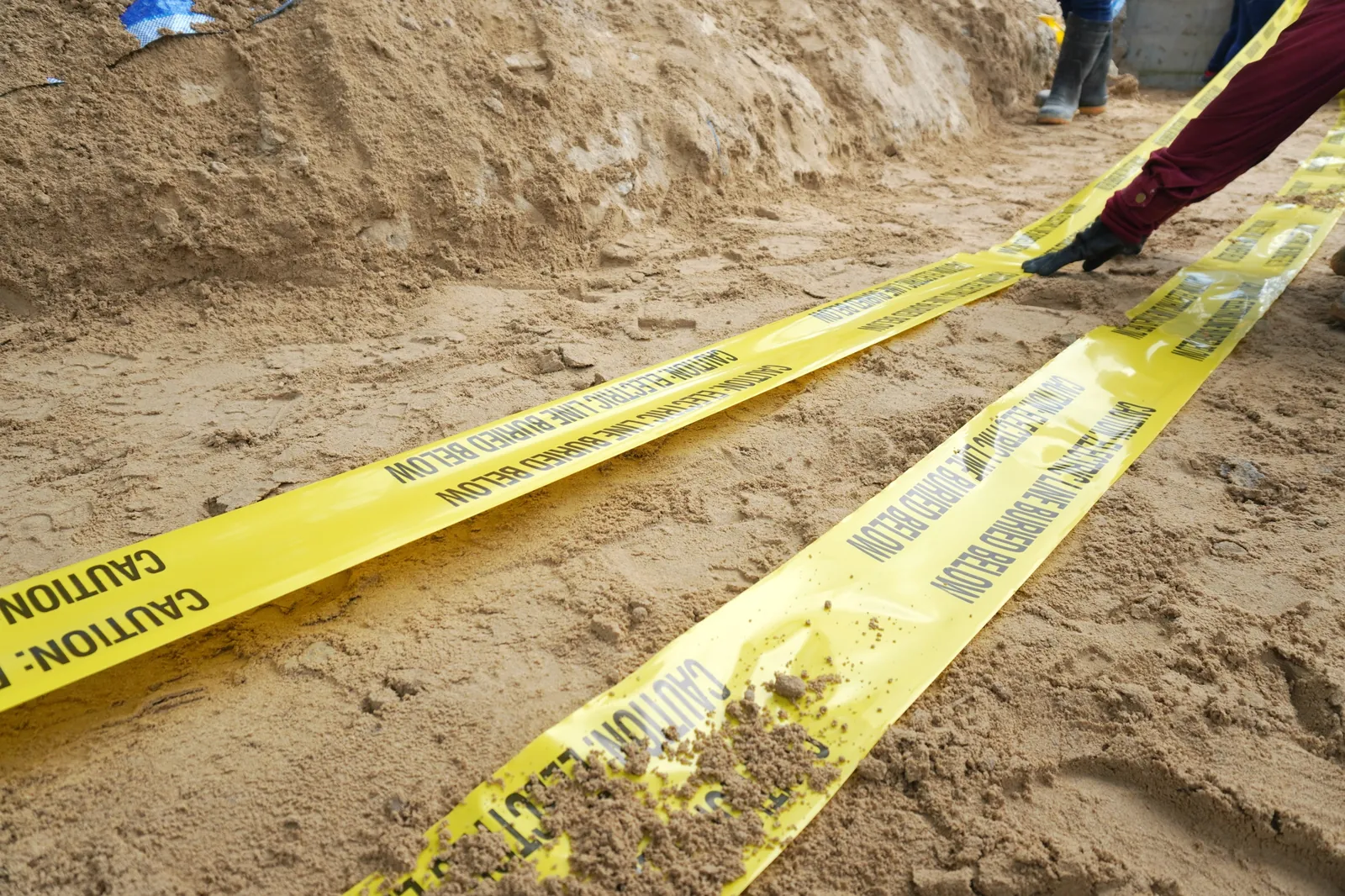
Where a buried utility crosses a road, a foundation or another service, Saudi spec writers escalate from tape to mat. A warning mat is a rigid or semi-rigid tile or continuous band of HDPE/PP, printed with the service legend, and in detectable form carrying a metal layer — aluminium foil or a stainless tracer strip — that a locator can find decades later. The Kingdom's utility programmes, from housing grids to giga-project corridors, consume them by the hundred thousand, and the supply base is overwhelmingly imported. We manufacture detectable and non-detectable warning mats at our Kalol plant in Gujarat and ship to Saudi contractors and traders on project schedules; this page sets out the practical import picture.
Construction: what the spec actually says
Non-detectable mats are moulded or extruded HDPE/PP panels, typically 300 x 300mm tiles or 200-400mm wide continuous mat in rolls, at 2 to 4mm effective thickness, printed bilingual with the service legend. Detectable versions integrate the metal layer — foil-laminated for locator response, or a stainless steel tracer for the premium segments — and some specs pair the mat with a separate tracer wire termination detail. The failure modes consultants check are edge integrity and legend durability: a mat that cracks when a worker kneels on it, or a legend that abrades off during backfill, fails inspection. We mould with UV-stabilised, cold-impact compounds and print legends deep enough to survive sandblasting-grade backfill, and every batch ships with material and dimensional certificates.
Duty, VAT and HS classification
Warning mats classify under HS 3926.90 as other plastic articles in most consignments, with some filings under 3920 sheeting depending on form. Saudi duty lands at 5% to 6.5% CIF, and VAT at 15% applies at import — the VAT is the number that moves a costing sheet, so keep duty and VAT as separate lines when comparing suppliers. There is no excise on this category and no minimum local-content gate at customs, though authority-linked tenders increasingly ask for factory audit evidence from the manufacturer, which we provide directly rather than through a trader.
SABER and tender paperwork
Where the conformity line applies, the importer registers the product on SABER and obtains the product and shipment certificates as with other plastic goods — budget one to two extra weeks on a first consignment while the product certificate is issued, then days per repeat shipment. On the tender side, mats enter through material submittals: consultants check construction, metal-layer presence, legend artwork and dimensions against the spec. Because we print project-specific legends and hold Gulf-standard bilingual artwork, Saudi contractors lock our mats into approved submittals and then reorder the identical item across the project life, which is exactly how the procurement should work.
Route, ports and project logistics
West Coast consignments run Mundra to Jeddah Islamic Port in four to seven days; Eastern Province projects clear at King Abdulaziz Port in Dammam, typically transhipping via Jebel Ali and adding about a week. Clearance takes two to five days once certificates are ready, then trucking to Riyadh, Qassim or project sites. Mats pack efficiently — a 40-foot container takes roughly 80,000 to 120,000 tiles depending on thickness, or the roll-format equivalent — and because mats are rigid, they stack without crushing concerns that plague tape. Production runs 8 to 12 days for stock legends, 14 to 18 days for project-specific mould print or tracer configurations. Giga-project buyers should plan deliveries against excavation fronts, not against container schedules: mat that lands before trenching is a line item, mat that lands after is a claim.
Documents and terms
Invoice, packing list, certificate of origin, bill of lading, batch material certificate and the SABER shipment certificate where applicable. FOB Mundra and CIF Jeddah or Dammam are the routine terms, with DDP project-site delivery quoted per package. Related items on the same bills: our warning mat product page lists tile and roll formats, underground warning tape covers the continuous-run marking between crossings, and caution tape rolls handle the surface barricading on the same safety budget.
Frequently Asked Questions
Detectable with foil or stainless tracer — which one?
Foil-laminated mats satisfy most locator-based specs; stainless tracer versions are specified on premium or long-life assets. Match the consultant's submittal wording — we produce both and will quote them as separate lines.
Can mats carry project-specific legends?
Yes — bilingual legends with developer, authority or project names are routine. Artwork and print approval takes about a week; we hold project tooling for reorder consistency.
What are the container quantities?
A 40-foot container takes roughly 80,000-120,000 tiles by thickness, or the equivalent in roll format. Mixed loads of mats plus tape are common on infrastructure packages.
How long is the lead time to a Riyadh project site?
Production 8 to 18 days, ocean 4 to 7 days to Jeddah plus transhipment for Dammam, clearance 2 to 5 days, trucking to Riyadh one day. Plan five to six weeks door to site on first orders.