American food brands and co-packers discovered what Indian laminate houses have known for a decade: rotogravure-printed multilayer pouches at US converter quality, at prices that change a brand's packaging line-item, shipped by the container from Gujarat. The category is technical — laminates, migration testing, FDA documentation — which is exactly why the brands that get sourcing right keep an advantage for years. We manufacture multilayer food grade pouches at our Kalol plant and supply US food brands, co-packers and packaging distributors; this page covers what the import involves.
What US buyers order
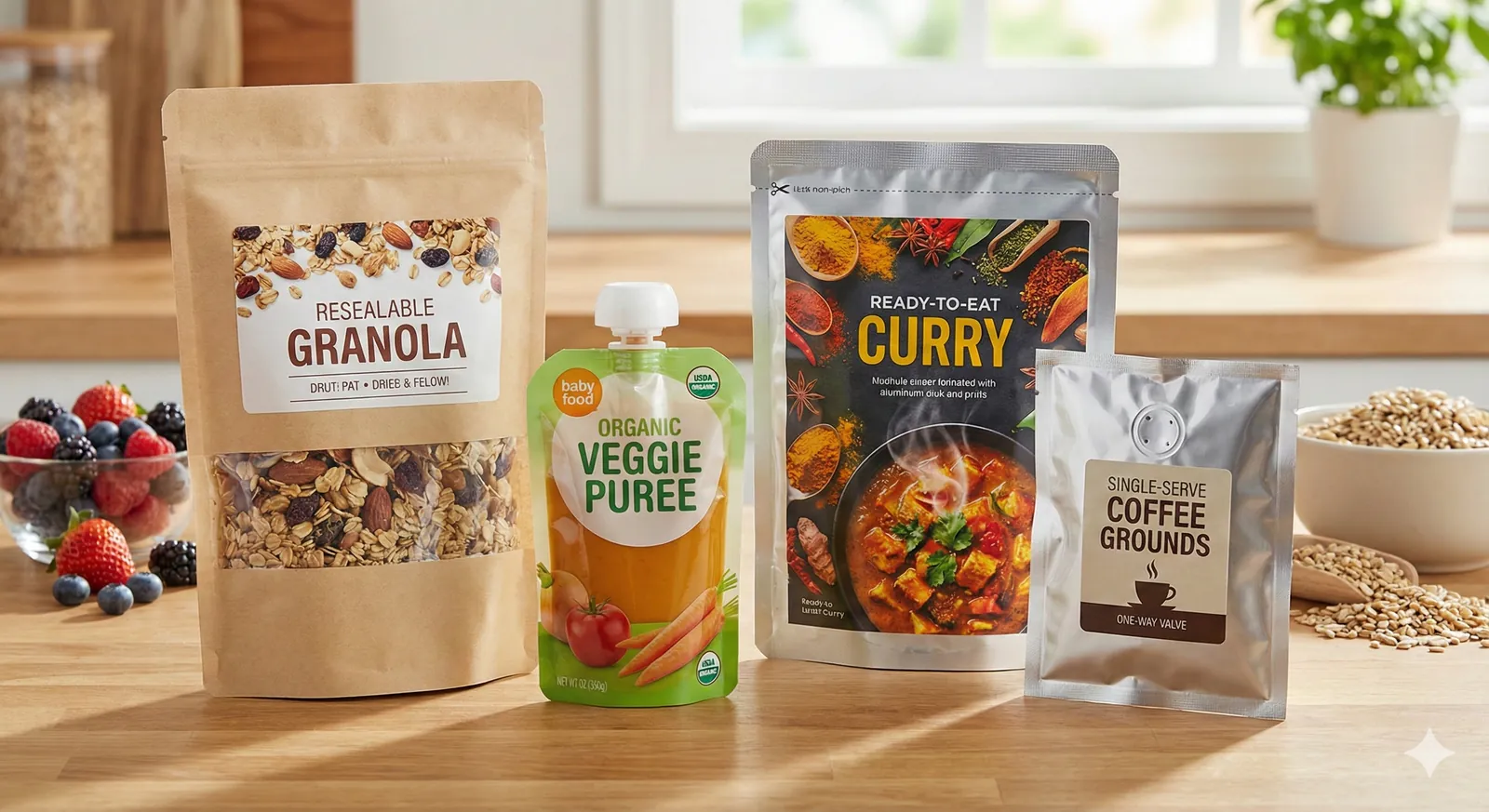
The laminate architecture follows the shelf-life requirement: PET/ALU/PE for maximum barrier (coffee, spices, retort-adjacent applications), PET/metallised-PE for mid-barrier snacks and powders, and transparent OPP/CPP or PET/PE structures where product visibility sells. Formats run from three-side-seal sachets to stand-up pouches with zippers and spouts, printed rotogravure up to eight-plus colours with reverse printing under the outer film so graphics scuff-proof on shelf. US buyers arrive with dielines and brand colour standards; we take it from artwork through cylinders to first-article approval, and repeat orders lock to the approved first article — the discipline that keeps a national brand looking like itself across reorder cycles.
Food-contact compliance — the part that actually matters
Food-contact compliance is the real entry ticket. The US framework runs through FDA food-contact regulations — 21 CFR 177.1520 for polyolefins, plus the relevant laminate and adhesive provisions — and sophisticated buyers ask for three things: FDA-status letters for each food-contact layer, migration testing against the intended use (food type, temperature, duration), and Good Manufacturing Practice documentation from the converting plant. We supply all three as standard, with third-party migration testing coordinated when a brand's QA requires it. One honest note: "FDA approved" is not a thing for materials — the correct claim is FDA-compliant status of the food-contact substances, and your regulatory adviser will appreciate a supplier who knows the difference and writes the paperwork accordingly.
Duty, VAT and classification
Multilayer pouches classify under HTS 3923.29 (other plastic sacks and bags), with Column 1 general rates around 3% to 5.3% depending on the line. Add the Merchandise Processing Fee at 0.3464% and Harbor Maintenance Fee at 0.125%, and — the 2026 change — the additional Section 301 action on Indian-origin goods of roughly 10%; confirm the live stack with your customs broker before quoting landed cost, because the surcharge level moved during 2026. Even with the full stack, Indian laminate pricing typically lands well below US converter pricing on run lengths above a few hundred thousand pouches — that is why co-packers source offshore despite the paperwork. ISF 10+2 is filed before loading; our document pack moves the same week production closes.
Ports, route and lead times
NY-NJ and Savannah serve East Coast co-packers, Houston the Gulf food corridor, LA/Long Beach the West; East Coast transit from Mundra runs 28 to 35 days port to port, clearance 2 to 4 days. Pouches ship flat and dense in cartons — excellent freight economics — and a 40-foot container carries millions of units depending on format. Production runs 15 to 21 days including cylinder engraving for new artwork; repeat orders on existing cylinders run 10 to 14 days. First orders land in seven to nine weeks door to door, repeats in five to six. Related sourcing: our food grade pouches product page lists laminate structures and formats, zipper pouches covers the simple reclosable end, and our guide to importing stretch film into the USA covers the same duty-stack logic for industrial film.
Frequently Asked Questions
What FDA documentation do you provide?
FDA-compliance status letters for each food-contact layer, third-party migration testing against your intended use, and GMP documentation from the converting plant — the package a US brand's QA and regulatory team expects.
Which laminate for coffee or spices?
PET/ALU/PE for maximum barrier and aroma; PET/metallised-PE where cost and shelf presence balance. Send shelf-life targets and we will propose the structure with rationale.
What is the total duty?
Base 3% to 5.3% by HTS line, plus MPF 0.3464% and HMF 0.125%, plus the 2026 Section 301 additional action on Indian-origin goods of roughly 10%. Your broker confirms the live stack.
How long is the lead time?
First orders 15 to 21 days production plus 28 to 35 days ocean East Coast — plan seven to nine weeks door to door. Repeats on existing cylinders run five to six weeks.