Ask a Gulf packing line what ruins a loaded container and the answer is never the bag fabric — it is moisture condensing on the inside walls as the shipment crosses from Gulf heat into cooler water and back. A jumbo bag without a liner in that cycle is a slow moisture exchange with the product inside, and by the time the clumping shows at the customer's silo, the claim is measured in tonnes. Liners are the cheapest insurance in bulk packaging, and for UAE buyers they are also the most misunderstood component. Here is the practical guide.
Liner types and where each one belongs
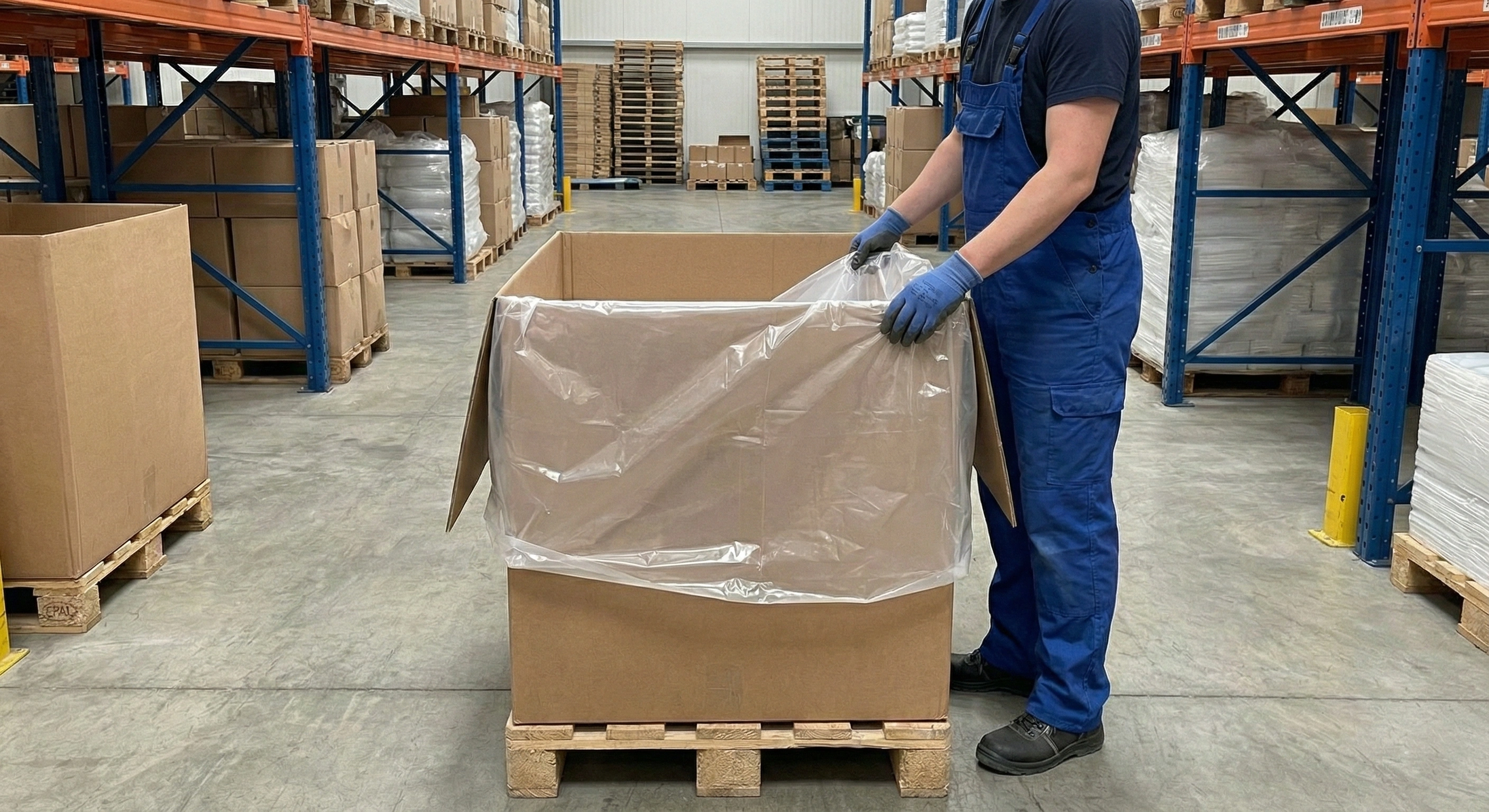
Tubular liners are the straightforward sleeve of LDPE or LLDPE dropped inside the bag — economical, effective, right for granules and pellets where a perfect wall-fit is not needed. Form-fit liners are shaped to the bag's dimensions, heat-sealed to follow the corners, and they are the answer for powders: no loose film folds to trap product at discharge, the bag empties clean. Barrier liners add layers — coextruded EVOH or aluminium foil constructions that block oxygen and odour as well as water, for cargo where a moisture or aroma spec is contractual. Thickness runs 50 to 125 micron by cargo weight and shelf journey. Anti-static liner options exist for static-prone powders, and bottom-discharge liners mate with the bag's discharge spout for filling lines that cannot afford product retention.
Food-contact documentation, without the scramble
Food-packers in the UAE — flour millers, sugar, dairy powders, food ingredients re-exported through Jebel Ali — need the liner's food-contact paperwork as part of their own audit chain. Our food-grade liners ship with the relevant declarations referencing the recognised food-contact regulations, and migration test documentation is available per liner lot. The declaration names the material, the additives and the conditions of use; your QA team files it once and the chain stops being a scramble every audit season. For non-food chemical cargo, the same discipline applies to the anti-static and barrier specifications — what the liner is, what it does, tested and batch-numbered.
Factory-fitted, and why that matters
The liner's value collapses if the fitting is done badly at the filling line — loose film caught in the fill spout, wrinkles that trap product, tops not sealed properly before the bag closes. We fit liners at the plant before baling: inserted, shaped, top-closed, then baled, so the bag arrives filling-line-ready and the operator mistake that ruins a liner's work is engineered out. MOQ for lined bags starts at 1,000 pieces, production about three weeks, and the Mundra to Jebel Ali leg lands them three to five days later — under a month to a UAE warehouse.
Frequently Asked Questions
Do my cargo actually need a liner in the UAE?
Hygroscopic powders, food ingredients, anything moisture-spec'd or shelf-journeyed: yes. Dry aggregates and pellets moving fast: usually not — send the product description and we give a straight answer.
Form-fit or tubular for flour?
Form-fit — the wall-fit shape empties completely and keeps flour away from trapped folds where moisture and product meet.
Can liners be printed or coloured?
Coloured liners are available for stream-identification; printing on liner film is uncommon, with bag print carrying the branding instead.
What is the MOQ and lead time for lined bags?
1,000 pieces for lined bags, about three weeks production plus three to five days to Jebel Ali.
Liner options are on the FIBC Liners page. For the moisture-barrier detail read why PE liners are the moisture barrier that matters, and for liner types compared see form-fit, tubular and food-grade liner options.