
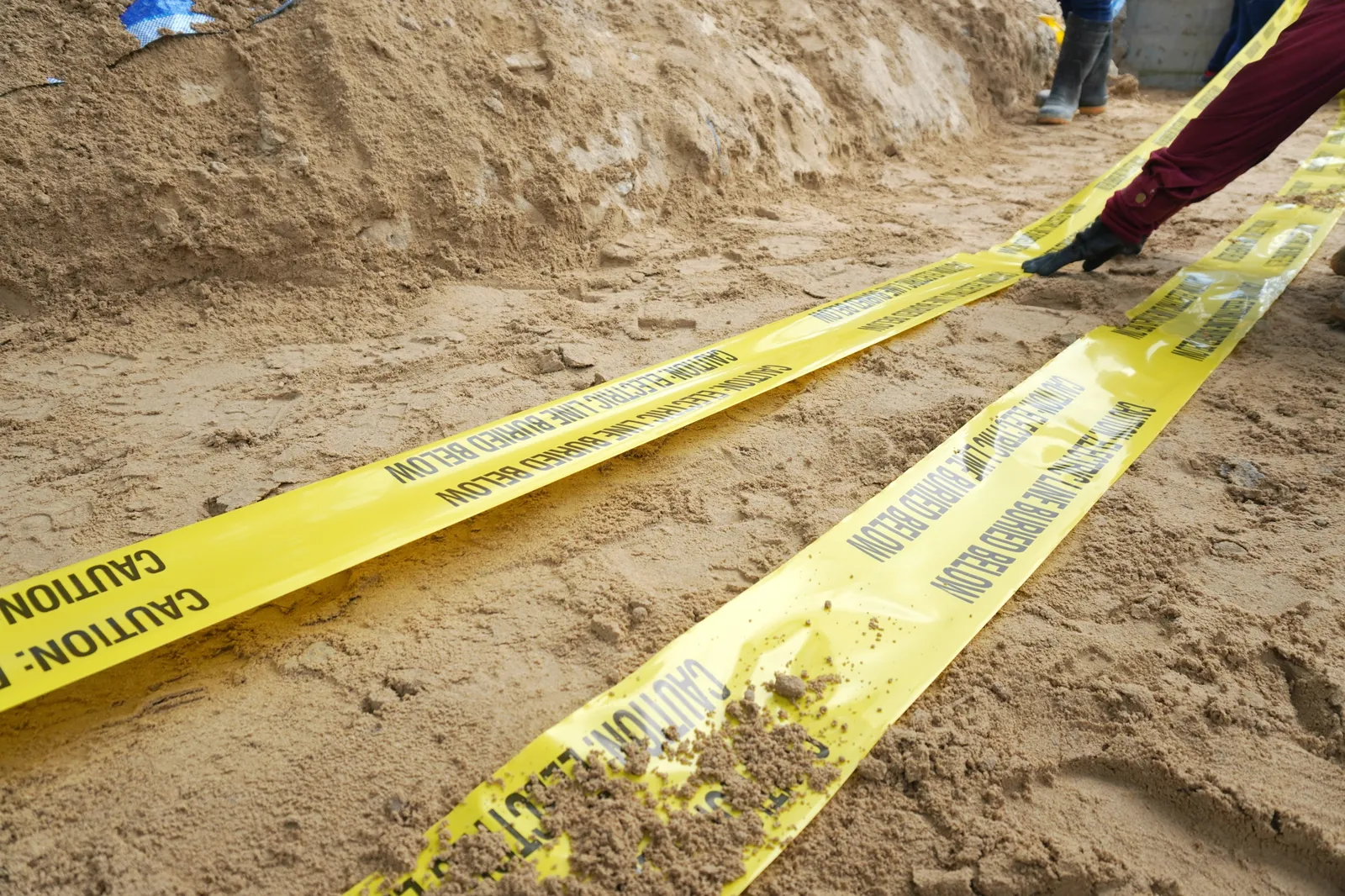
Every excavation strike on a buried utility traces back to somebody, somewhere, skipping a ₹200 precaution. Underground warning tape is that precaution — a continuous coloured band buried above cables and pipelines that makes an excavator operator stop before the bucket hits live infrastructure. For Indian utilities, gas companies and EPC contractors, this guide covers the specification details that separate tape that works from tape that is just colourful plastic in the ground.
The Colour Code System (APWA Standard)
India's utility sector largely follows the APWA (American Public Works Association) uniform colour code, and every serious contractor knows it by heart:
- Red: electric power lines and cables
- Yellow: gas, oil, steam, petroleum
- Orange: telecom, fibre optic, CATV
- Blue: potable water
- Green: sewers, drainage
- Purple: reclaimed/non-potable water
- White: proposed excavation limits
Using the right colour is not pedantry — response crews diagnose what they have hit by tape colour before they see the utility. Wrong colour means wrong assumptions during an emergency. Our underground warning tape line covers the full APWA range with standard utility legends printed throughout.
Detectable vs Non-Detectable — The Decision That Matters Most
Non-detectable tape is printed poly film: cheap, effective as a physical stop-warning, invisible to locators. Detectable tape carries an aluminium foil core or stainless steel wire that cable avoidance tools (CAT and Genny locators) can find from surface — even years after burial when surface markers are long gone. The selection rule:
- Non-detectable: services whose route is well-documented and locatable by other means — the tape is the last passive warning
- Detectable: non-metallic services (HDPE water and gas pipes, fibre ducts) that locators otherwise cannot find — the tape becomes the finding mechanism
That second category is where Indian utilities increasingly specify detectable tape, because HDPE pipe adoption has exploded and HDPE is invisible to traditional metal locators. Detectable tape costs roughly 3-5x non-detectable, and it is worth every rupee on non-metallic runs.
Correct Installation Depth and Method
The specification that gets tape installations rejected in audits:
- Depth below finished grade: 300-500mm above the buried service — deep enough to survive surface works, shallow enough to be hit first
- Continuous and taut: no floating or coiling; tape should lie flat on the protective sand layer
- Overlap joints: minimum 500mm overlap between roll ends — a gap is a false all-clear
- Print orientation: legend facing up where practical for later inspection during maintenance digs
- Sand bed: 100mm sand below and above the service with tape above the top sand layer — stones pressed against cable insulation cause slow-brewing faults
For a deeper technical treatment including tape material chemistry, see our APWA colour code technical guide.
Pricing for Indian Buyers (2026)
Indicative ex-works rates per roll (standard 365m utility rolls, 3 inch):
- Non-detectable, 100 micron: ₹350-550 per roll
- Non-detectable, 150 micron heavy: ₹500-750 per roll
- Detectable (foil-core), 100-150 micron: ₹1,200-1,900 per roll
Compare that against the cost of an excavation strike — a single HV cable strike routinely costs lakhs in repair, outage penalties and inquiry downtime, before anyone discusses safety. The tape is the cheapest insurance in the entire utility bill of materials. Rates exclude 18% GST and freight.
Material Quality — What Fails Underground
Buried tape faces decades of moisture, soil acids and alkalis, and pressure from backfill. Cheap tape with inadequate stabilisers disintegrates into fragments within a few years — worthless precisely when it is needed. Specify: 100% virgin HDPE/LDPE film, acid and alkali resistance declaration, and printed legend ink that survives wet-soil conditions (buried ink failure is common in cheap imports). For critical runs, ask for samples to be buried in site soil for a month and exhumed — a 30-day test that predicts 30-year performance better than any brochure.
Frequently Asked Questions
At what depth should underground warning tape be buried?
Standard practice is 300-500mm below finished grade and above the buried service, sitting on the protective sand layer. Deep enough to survive surface activity, shallow enough to be excavated before the utility is reached.
What is the difference between detectable and non-detectable warning tape?
Detectable tape has a metal (aluminium foil or SS wire) core locatable from the surface with standard utility locators; non-detectable is printed poly film only. Use detectable tape above non-metallic services like HDPE pipes and fibre ducts that locators cannot otherwise find.
Which colour warning tape for underground cables?
Red for electrical, orange for telecom/fibre, per the APWA code that Indian utilities follow. The full code: yellow for gas/petroleum, blue for water, green for sewerage, purple for reclaimed water.
How much does detectable warning tape cost in India?
Indicative 2026: ₹1,200-1,900 per 365m roll for 100-150 micron foil-core detectable tape, versus ₹350-550 for non-detectable. Rates ex-works, excluding GST and freight.