
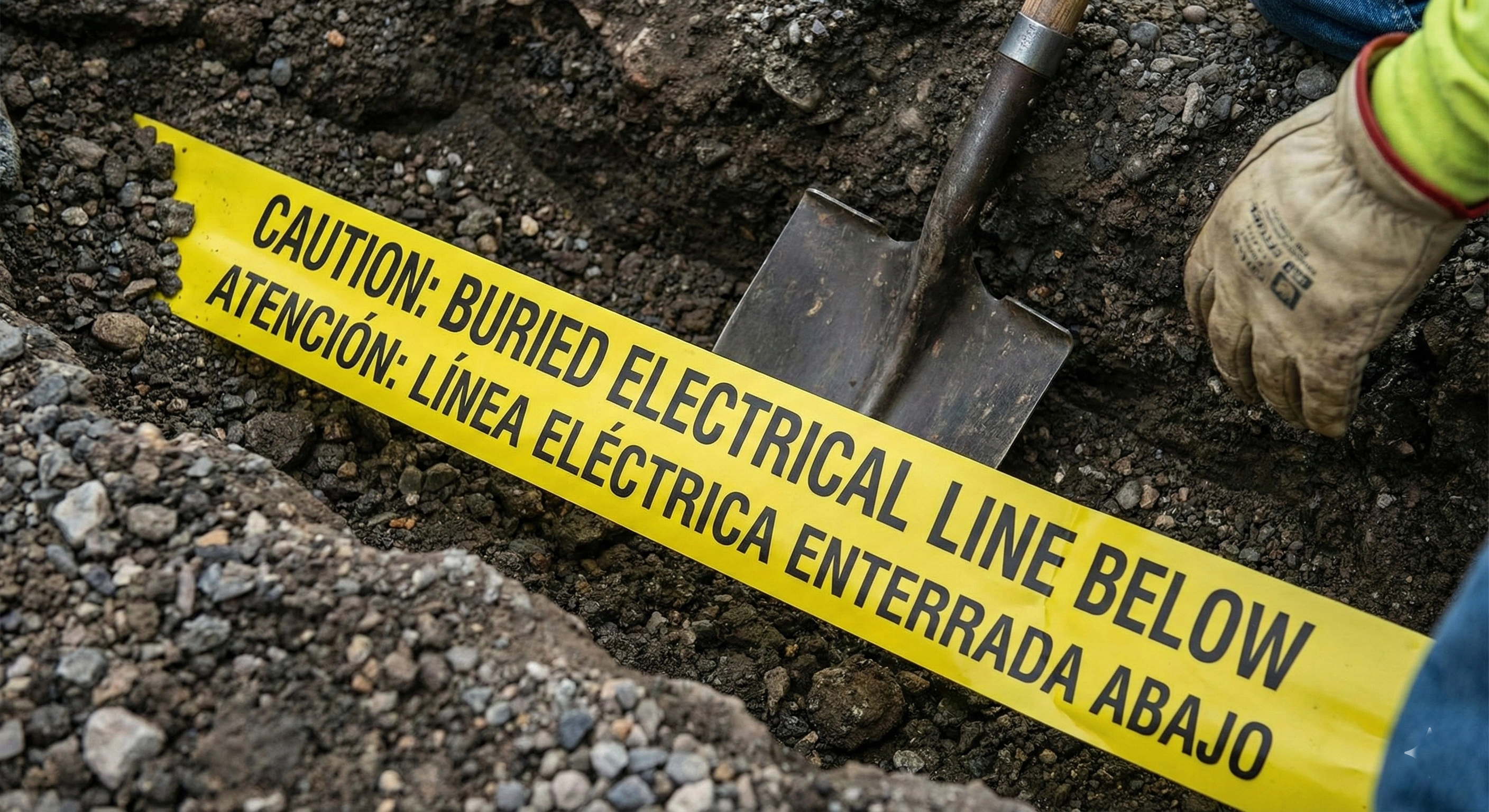
In the world of civil engineering and subsurface excavation, guessing is fatal. Striking an underground high-voltage cable or pressurized gas line can cause explosions, project shutdowns, and loss of life. To prevent this, the industry relies on a standardized system: The APWA Uniform Color Code.
For contractors and municipal planners, understanding these color codes and specifying the right technical tape is not just about compliance—it is about life safety.
What is the APWA Uniform Color Code?
The American Public Works Association (APWA) established a universal color code to temporarily mark and permanently identify underground utility lines. Before you specify underground warning tapes, you must know the standard:
RED: Electric power lines, cables, conduit, and lighting cables. (High Danger: Lethal shock hazard)
YELLOW: Gas, oil, steam, petroleum, or gaseous materials. (High Danger: Explosion/Fire hazard)
ORANGE: Communication, alarm or signal lines, cables, or conduit. (Fiber optics/Telecom)
BLUE: Potable water. (Drinking water lines)
GREEN: Sewers and drain lines. (Wastewater/Stormwater)
PURPLE: Reclaimed water, irrigation, and slurry lines.
WHITE: Proposed excavation routes or borders.
PINK: Temporary survey markings.
Technical Specs: Detectable vs. Non-Detectable Tapes
Choosing the right color is only half the specification. Engineers must also specify the construction type based on the utility locating method:
Non-Detectable Warning Tape (Standard PE): Made from durable low-density polyethylene. It acts as a visual warning during hand-digging. Specification Use: For non-critical lines like sewer, drainage, or fiber optics where the exact location is already mapped.
Detectable Warning Tape (Metalized Core): Features a laminated core of stainless steel or aluminum foil sandwiched between PE layers. It can be located using standard electromagnetic pipe locators above ground before digging begins. Specification Use: Mandatory for high-risk lines like high-pressure gas and high-voltage electricity.
Engineering Installation Standards
To ensure the tape functions correctly as a warning barrier, depth and placement are critical:
Placement Depth: The tape must be buried 12 to 18 inches (30-45 cm) directly above the utility line. This ensures that a backhoe operator hits the tape before hitting the pipe.
Trench Width: The tape should span the width of the trench to ensure it cannot be missed.
Soil Backfill: Always lay the tape on a layer of clean, stone-free backfill to prevent sharp rocks from puncturing the tape before the final cover.
Global Terminology for Utility Safety Tapes
When specifying subsurface safety materials for international projects, engineers use specific regional terms:
In Germany & Austria: Contractors specify "Erdkabel Warnband" (Underground cable warning tape) or "Ortbares Warnband" (Detectable warning tape) to comply with DIN standards.
In France: Engineers search for "Ruban de signalisation enterré" or "Ruban détectable" for utility mapping.
In Spain & Mexico: Planners look for "Cinta de señalización enterrada" or "Cinta detectable para tuberías".
In the Middle East (UAE): Municipalities require "شريط إنذار الكابلات" (Cable warning tape) or "شريط تحذير للمرافق" (Utility warning tape) for infrastructure projects.
In Brazil: Engineers specify "Fita de advertência enterrada" or "Fita detectável".
Siddhii Global: Engineer-Grade Warning Tape Manufacturer
As a leading manufacturer based in Kalol, Gujarat, Siddhii Global produces Underground Warning Tapes that meet the strictest global engineering specs. We offer:
Full APWA Color Range: All 8 standard colors with high-contrast black printing.
Detectable Foil Core: 30-micron to 50-micron metalized cores for reliable electromagnetic detection.
Custom Print Legends: Print specific utility texts (e.g., "CAUTION: BURIED GAS LINE BELOW") in English, Arabic, or Spanish.
Internal Linking Opportunities:
Why are these tapes critical? Read Preventing Excavation Disasters: The Critical Role of Underground Warning TapeDon't leave subsurface safety to chance. Specify the right code.
Need engineer-grade warning tapes?
Explore our Underground Warning Tape Range or contact us for a custom export quote!