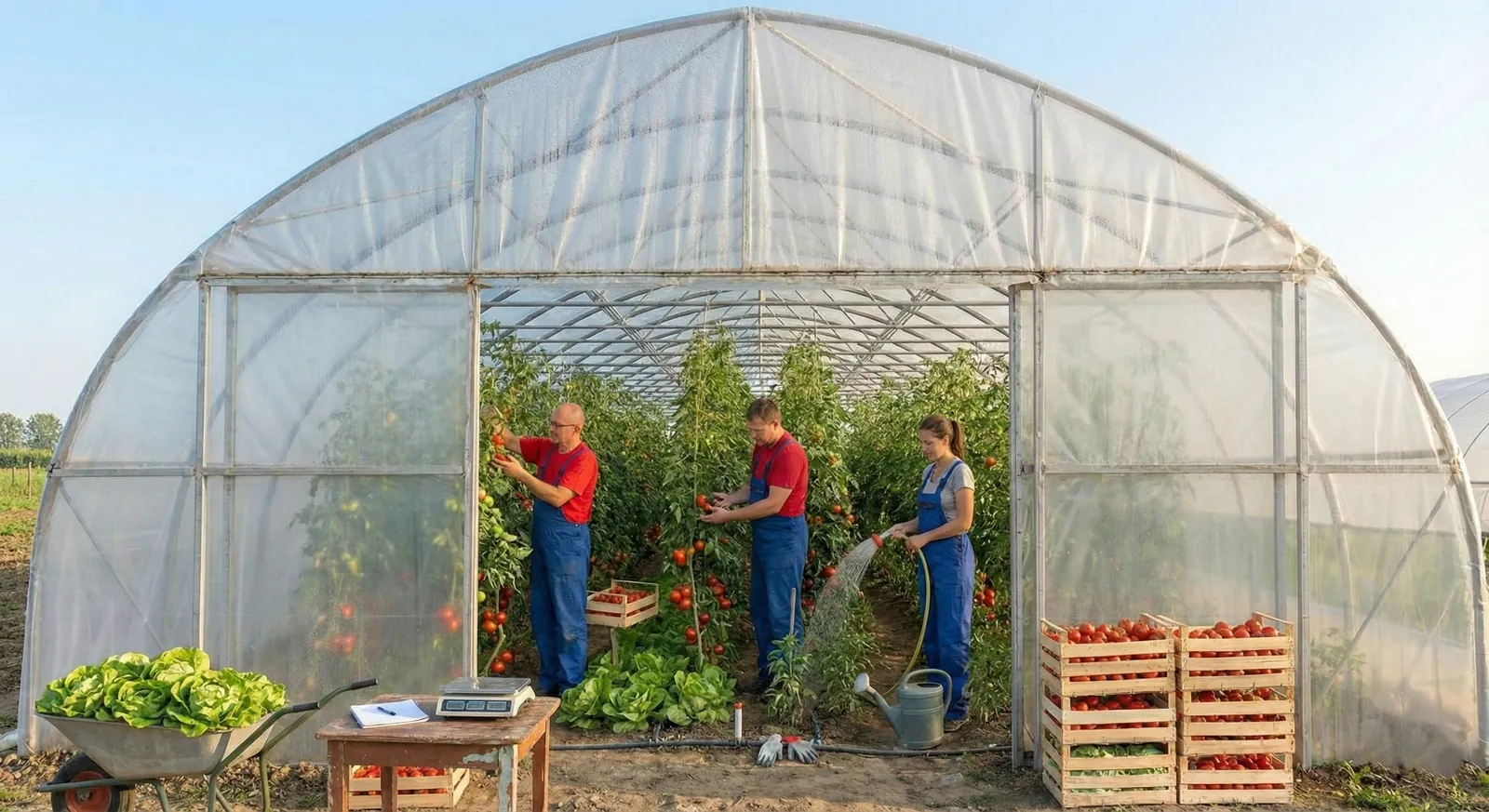
Canada runs one of the world's great greenhouse stories in the most unlikely climate for it. Around Leamington and Kingsville in Ontario — one of the largest greenhouse concentrations in North America — plus operations across Quebec, BC's Lower Mainland and the prairies, Canadian growers produce vegetables and flowers through continental winters under plastic. The film that makes that possible is specified for the opposite problem to the Gulf: not keeping heat out, but keeping it in.
Applications: the Canadian greenhouse economy
The Ontario belt grows tomatoes, cucumbers and peppers at industrial scale in glass and poly structures; the poly sector re-covers on a two-to-four season cycle and consumes film continuously. Quebec and the Maritimes run vegetable and ornamental operations; BC mixes berries and vegetables under poly; and the prairie provinces run season-extension greenhouses where the thermal cover is the difference between a crop and a loss. Canadian buyers also run over-wintering structures, nursery poly houses and seasonal retail covers — a spread of formats that all share one spec driver: thermal performance through winters that can hold a structure under snow load and minus-twenty nights.
Specs for the continental winter
The Canadian workhorse is 150 to 200 micron three-layer polyethylene with a serious thermal (IR) barrier — the film's job through winter is to hold the heat the heating system paid for, and IR-blocking layers are the spec that decides heating bills. Anti-drip treatment runs on every interior face: condensation in a cold-climate greenhouse drips on crops and freezes, so water management through the film is non-negotiable. Anti-dust behaviour, light diffusion for vegetable programs and UV packages sized to full multi-season service complete the stack. The distinctive Canadian structure detail is the double-poly inflated roof — two film layers with a blower-inflated air gap — and film for that system needs the thickness and tensile to hold inflation reliably for the full service life.
Import flow: duty, GST and ports
Polyethylene film under HS 3920.10 enters Canada at low or nil MFN duty in most cases — your broker confirms the current line — with 5% GST payable on import and creditable for GST-registered businesses. Containers reach Montreal or Toronto-region gateways via the East Coast services from Mundra in roughly 35 to 45 days, which makes the re-covering calendar the most important planning variable in the program: spring re-cover stock confirmed by late winter, containers landing with weeks to spare, not days. The document set is standard, and third-party pre-shipment inspection is available for buyers who verify micron, width and feature stack before loading.
Frequently Asked Questions
What film suits the double-poly inflated roof?
150 to 200 micron three-layer film with the tensile to hold inflation reliably — we supply the construction data Canadian installers ask for.
Which layer matters most in Canada?
The thermal (IR) barrier — through a continental winter it is the spec that decides heating cost, and Canadian buyers price it accordingly.
What duty and tax apply on import?
Low or nil MFN duty under HS 3920.10 in most cases (broker confirms the line) plus 5% GST, creditable for GST-registered businesses.
When should spring re-cover stock be ordered?
By late winter: East Coast transits run 35 to 45 days from Mundra, and the cover should land weeks before the re-covering window, not days.
Cover specifications are on the Greenhouse Film page. For the opposite climate problem read the UAE desert greenhouse guide, and for import mechanics see the Australia import guide.