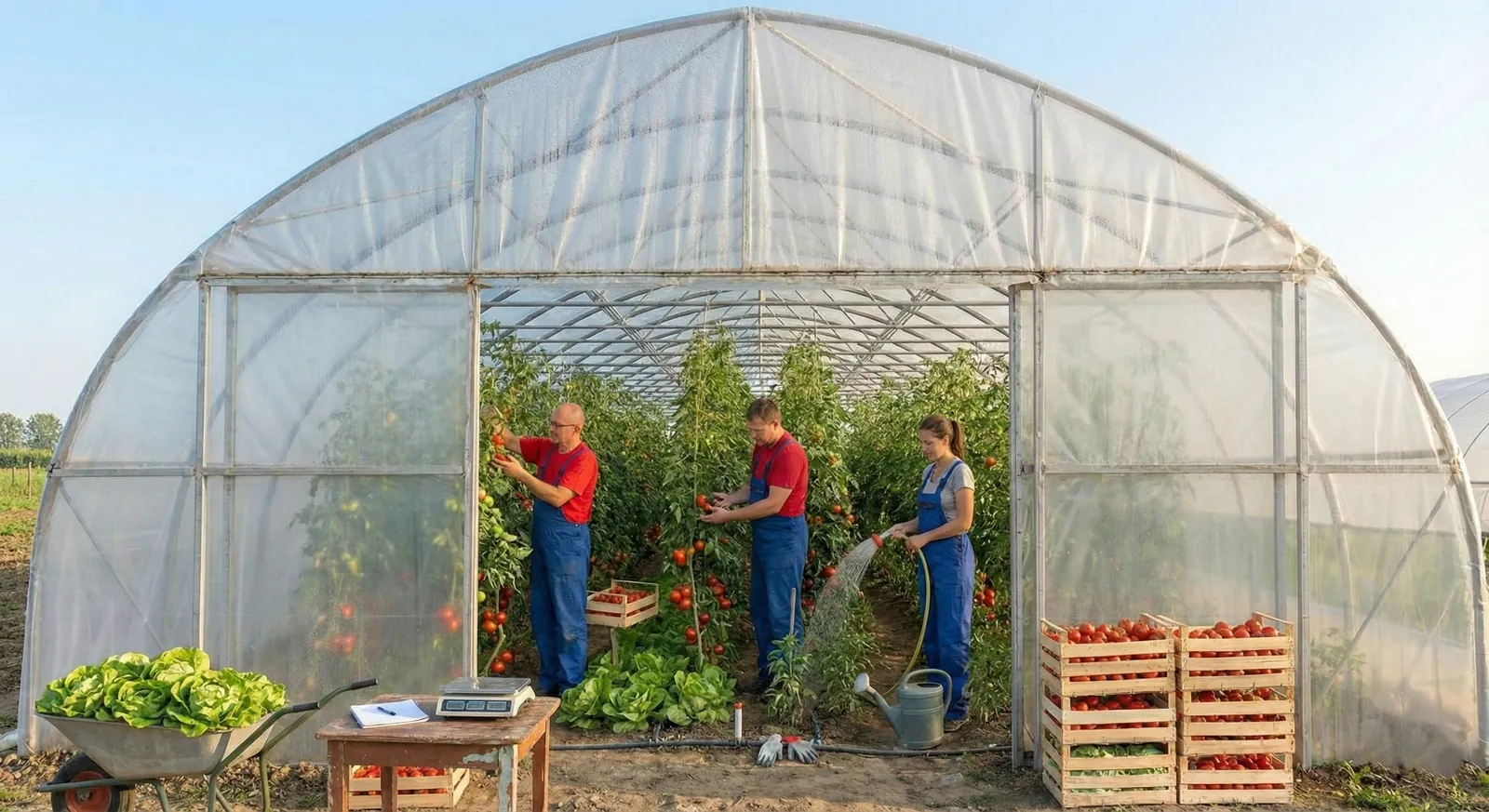
The UAE has become an unlikely greenhouse laboratory. Commercial controlled-environment growers across the country grow premium produce in desert conditions, and the technology that makes it work starts with the cover: a film that must keep extreme heat out, hold humidity where the plants want it, survive irradiance that would destroy generic polyethylene in a season, and work with the cooling systems that make desert growing possible. Buying greenhouse film for the UAE is a systems decision, not a commodity purchase.
What UAE growers actually spec
The standard desert cover is 150 to 200 micron three-layer polyethylene with a feature stack: UV stabilisation validated for Gulf irradiance levels, thermal (IR) barrier in the middle layer to hold night temperatures in winter months, anti-drip (AF) treatment so condensation runs down the film instead of dripping on crops, and anti-dust surface behaviour because desert dust on a cover costs light and light is yield. Light diffusion variants spread radiation through the canopy instead of shadowing it — a meaningful yield effect for high-wire crops. Films run three to four season warranties in this market, and growers re-cover on a schedule rather than waiting for failure, because a torn cover in a desert summer is a crop-loss event, not a maintenance item.
The systems conversation: cooling and cover
UAE greenhouses run evaporative cooling — fan-and-pad systems where the cover's role is to hold the cooled, humidified air. That is why anti-drip matters so much here: condensation on the underside must run to the gutter, and film that drips onto crops in a cooling-pad house creates disease pressure fast. Growers also match light transmission to crop and season, and we supply transmission data per film type so the conversation happens on numbers. The technical dialogue is the reason UAE growers buy from manufacturers rather than traders — the wrong cover with the right cooling system still loses the crop.
Import flow and programme structure
Film ships folded and rolled from Mundra to Jebel Ali in 3 to 6 days port to port at the GCC standard 5% CIF duty under HS 3920.10. Cover programmes run on re-covering cycles: growers hold width and feature specs as standards, order before the season they re-cover, and repeat containers land inside four weeks door to door. UAE distributors often combine greenhouse film with mulch and silage lines per container — all ship in compatible roll formats. MOQ starts at container level with mixed widths, which matches how the market actually buys.
Frequently Asked Questions
What micron cover suits UAE conditions?
150 to 200 micron three-layer film with Gulf-validated UV, thermal barrier and anti-drip — thinner generic film fails within one desert season.
Why does anti-drip matter so much here?
In fan-and-pad cooled houses, condensation must run to the gutter; dripping film creates disease pressure on crops fast.
What duty applies at Jebel Ali?
The GCC standard 5% CIF duty on polyethylene film under HS 3920.10 — your clearing agent confirms the line and documents.
How does a re-covering programme work?
Widths and features held as standing specs; order one cycle before re-cover season and repeat containers land in about four weeks door to door.
Cover specifications are on the Greenhouse Film page. For the open-field side read the UAE mulch film guide, and for UV stabilisation strategy see the desert UV guide.