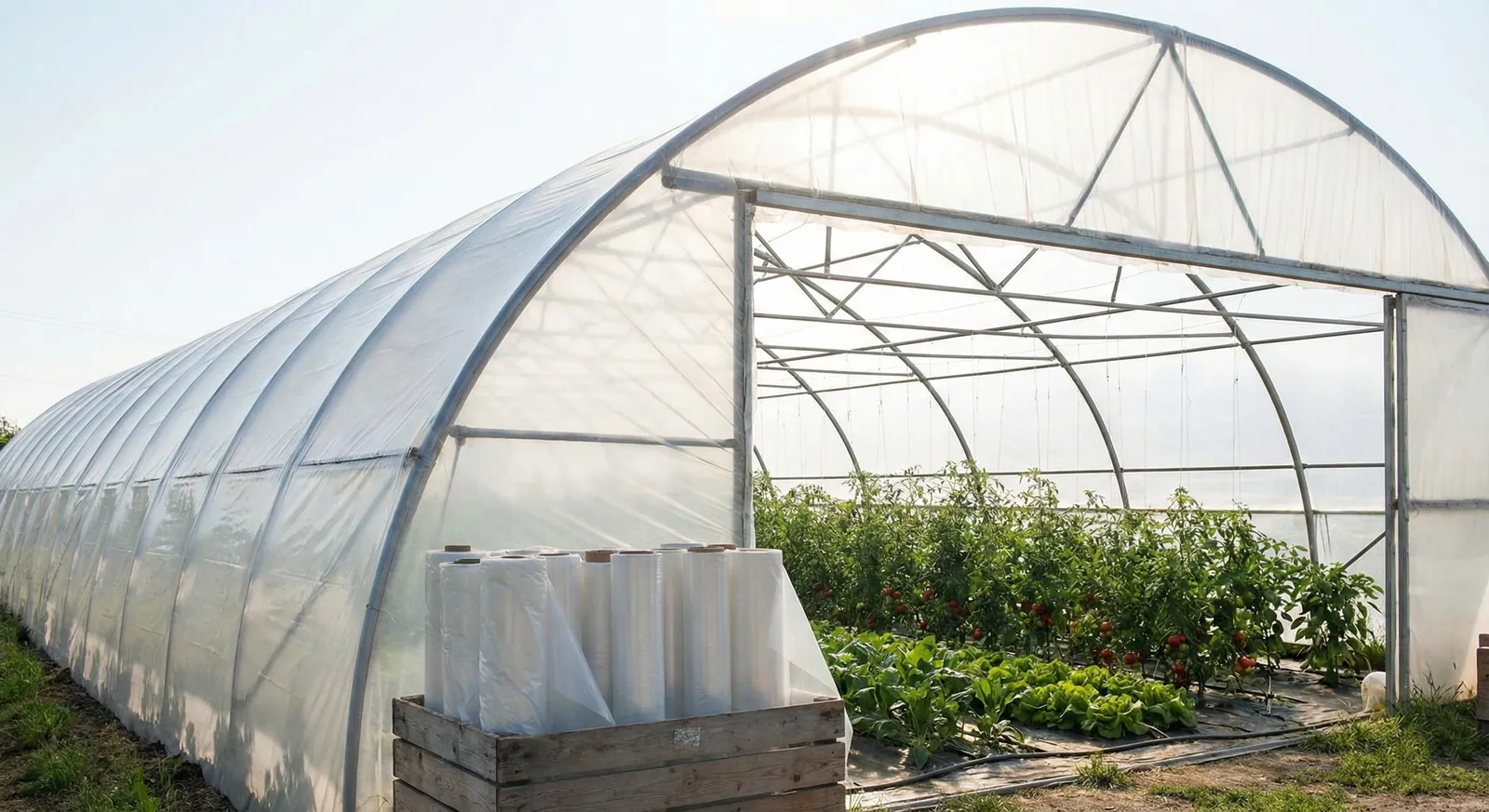
Qatar's greenhouses operate in one of the two hardest film environments on earth — desert irradiance by day, cooled humid air by night — and the covers that survive here are engineered for exactly that cycle. The country's food security investment has built serious protected cropping capacity, and the growers running it verify specifications with more discipline than most markets we ship to. The checklist below is what a Qatar-bound film order goes through before it leaves our plant.
Specs that survive the desert cycle
The Qatari standard cover is 150 to 200 micron three-layer polyethylene: UV stabilisation validated for Gulf irradiance levels — generic packages fail within a season here — a thermal (IR) barrier for winter nights, anti-drip treatment because fan-and-pad cooled houses run humid and condensation must reach the gutter, and anti-dust surface behaviour for a country where dust is a standing tax on light transmission. Light diffusion variants serve the high-wire vegetable programmes where even radiation through the canopy is a yield strategy. Three-to-four season service life is the honest expectation, and growers re-cover on schedule — a summer cover failure is a crop event, not a maintenance ticket.
The verification checklist we run
Every Qatar-bound lot gets: micron and width audit per roll, UV validation against the specified package, anti-drip surface testing, light transmission and diffusion data per film type, tensile and elongation on the base film, and crease-quality inspection on folded wide covers — a crease is a future failure line, and on wide covers the folding discipline matters as much as the film itself. Third-party pre-shipment inspection is available and used by several Qatari buyers; the report ships with the container and slots into the supplier file.
Import flow: Hamad Port and the calendar
Film ships rolled from Mundra to Hamad Port in roughly 5 to 9 days — the fastest lane in our greenhouse film book. GCC customs applies the standard 5% CIF duty on polyethylene film under HS 3920.10 with a simple document set: invoice, packing list, bill of lading, certificate of origin. The re-covering calendar drives ordering: growers hold specs as standards and confirm one cycle ahead of the re-cover window, and repeat containers land inside four weeks door to door. Mixed-width containers are the norm for distributors serving multiple greenhouse programmes.
Frequently Asked Questions
What cover spec suits Qatari greenhouses?
150 to 200 micron three-layer film with Gulf-validated UV, thermal barrier, anti-drip for cooled houses and anti-dust behaviour; wide formats for modern structures.
Why is anti-drip treatment critical here?
Fan-and-pad cooled houses run humid — condensation must run to the gutter, and dripping film creates disease pressure on crops fast.
What duty applies at Hamad Port?
The GCC standard 5% CIF duty on polyethylene film under HS 3920.10 — your clearing agent confirms the line and documents.
How is crease damage on wide covers avoided?
Folding and rolling on equipment that treats crease management as a spec — we inspect every folded cover, and pre-shipment reports show it.
Cover specifications are on the Greenhouse Film page. For the wider Gulf picture read the UAE greenhouse film guide, and for open-field applications see the Qatar mulch film applications guide.