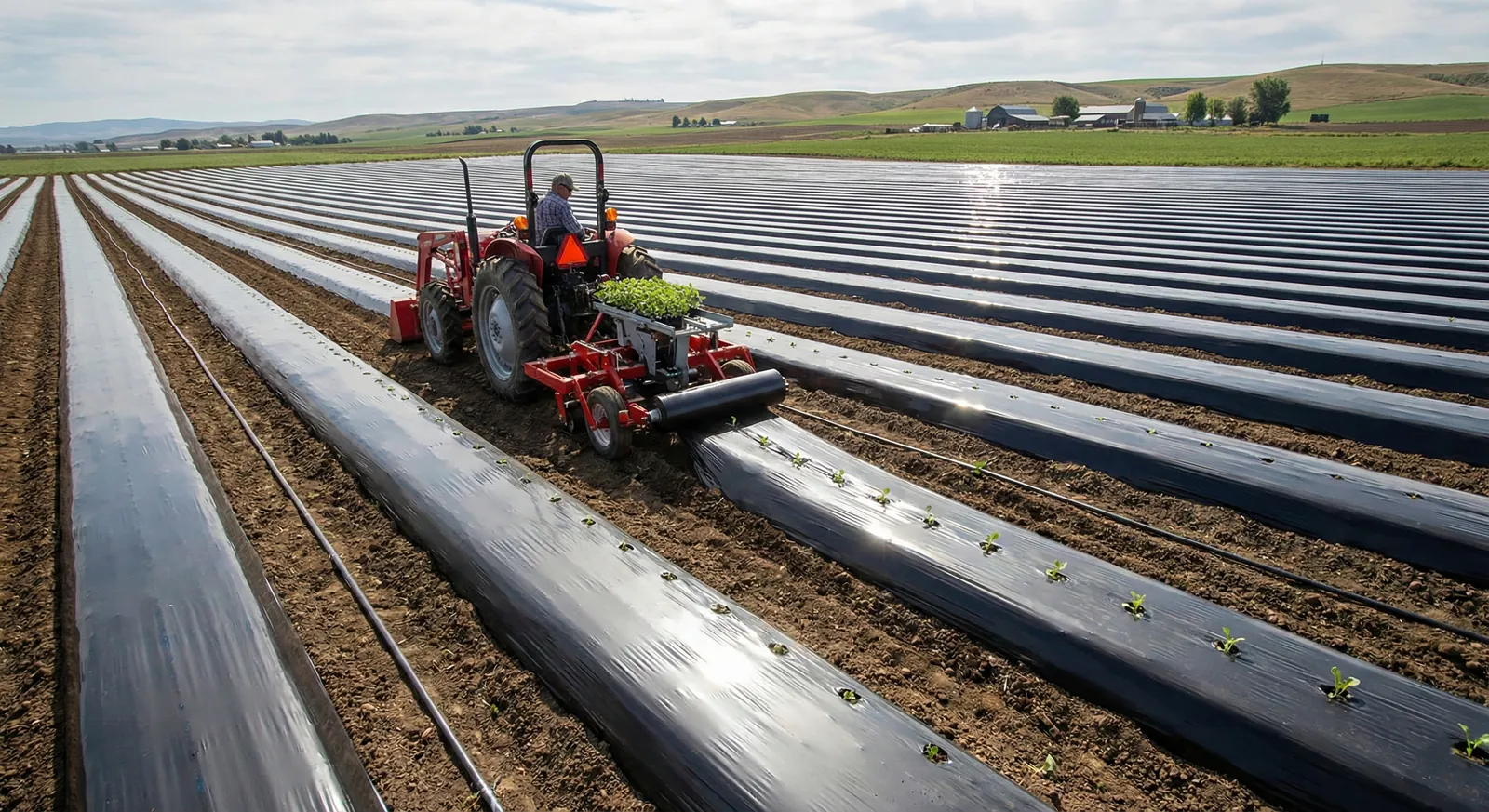
Qatar grows food under the hardest conditions in the Gulf: sand, sun and a national determination to produce more of it locally. The country's food security programmes have poured investment into commercial farms and dairy ventures, and every one of those operations faces the same agronomic truth — every drop of irrigation water that evaporates from bare soil is a drop bought twice. Mulch film attacks that loss directly, which is why it has become standard equipment across Qatari open-field and protected cropping operations.
Applications: where film earns its keep
Open-field vegetables — tomato, cucumber, melon, pepper — run black or silver-black mulch over drip lines, 25 to 40 micron with UV packages sized to brutal Gulf irradiation. Forage and dairy ventures, which Qatar has built at serious scale to feed its dairy herds, use film across feed crop beds and rely on silage film on the storage side — two films, one water-saving logic. The landscape and beautification sector, which has grown enormously with the country's urban development, buys mulch and ground cover for ornamental beds where weed suppression without herbicide is the whole point. Each application tunes the same chassis: micron by crop cycle, colour by season, width by bed.
The desert UV reality
Qatari sun is among the most aggressive UV environments agriculture operates in — film specified with generic European UV packages fails mid-season here, and a mid-season film failure on a food security programme farm is not a small problem. We build Gulf-grade stabilisation into every roll destined for the Gulf states, validated against the irradiation levels the region actually delivers, and we size the package to the crop cycle plus a buffer. Silver-black through peak summer, black for cooler plantings — the same logic as the wider Gulf, applied with Qatari summer in mind.
Import flow: Hamad Port and GCC customs
Film rolls ship from Mundra to Hamad Port in roughly 5 to 9 days — one of the shortest agriculture-film lanes we run. GCC customs applies the standard 5% CIF duty on polyethylene film under HS 3920.10, with a straightforward document set: invoice, packing list, bill of lading, certificate of origin. Most Qatari importers are agricultural distributors serving multiple farm programmes, and mixed-width containers are the norm — one FCL combining the specifications three or four customers need, colour-separated by roll. Repeat cycles run fast on this lane: order to door inside four weeks on repeats is routine.
Frequently Asked Questions
Which colour suits Qatari summer?
Silver-black through peak summer — reflection keeps root zones cooler; black suits winter and shoulder-season plantings where soil warming helps.
How long does the UV package need to last?
Size to the crop cycle plus buffer: six month film for most rotations, twelve month grades for long cycles — built for Gulf irradiation, not generic conditions.
What duty applies at Hamad Port?
The GCC standard 5% CIF duty on polyethylene film under HS 3920.10 — your clearing agent confirms the line and documents.
Can we combine specifications per container?
Yes — mixed widths and colours per FCL, colour-separated, which is how Qatari distributors serve multiple farm programmes from one container.
Film specifications are on the Mulch Film page. For the wider Gulf picture read the UAE and Gulf mulch guide, and for the storage side of feed programmes see the UAE silage film guide.