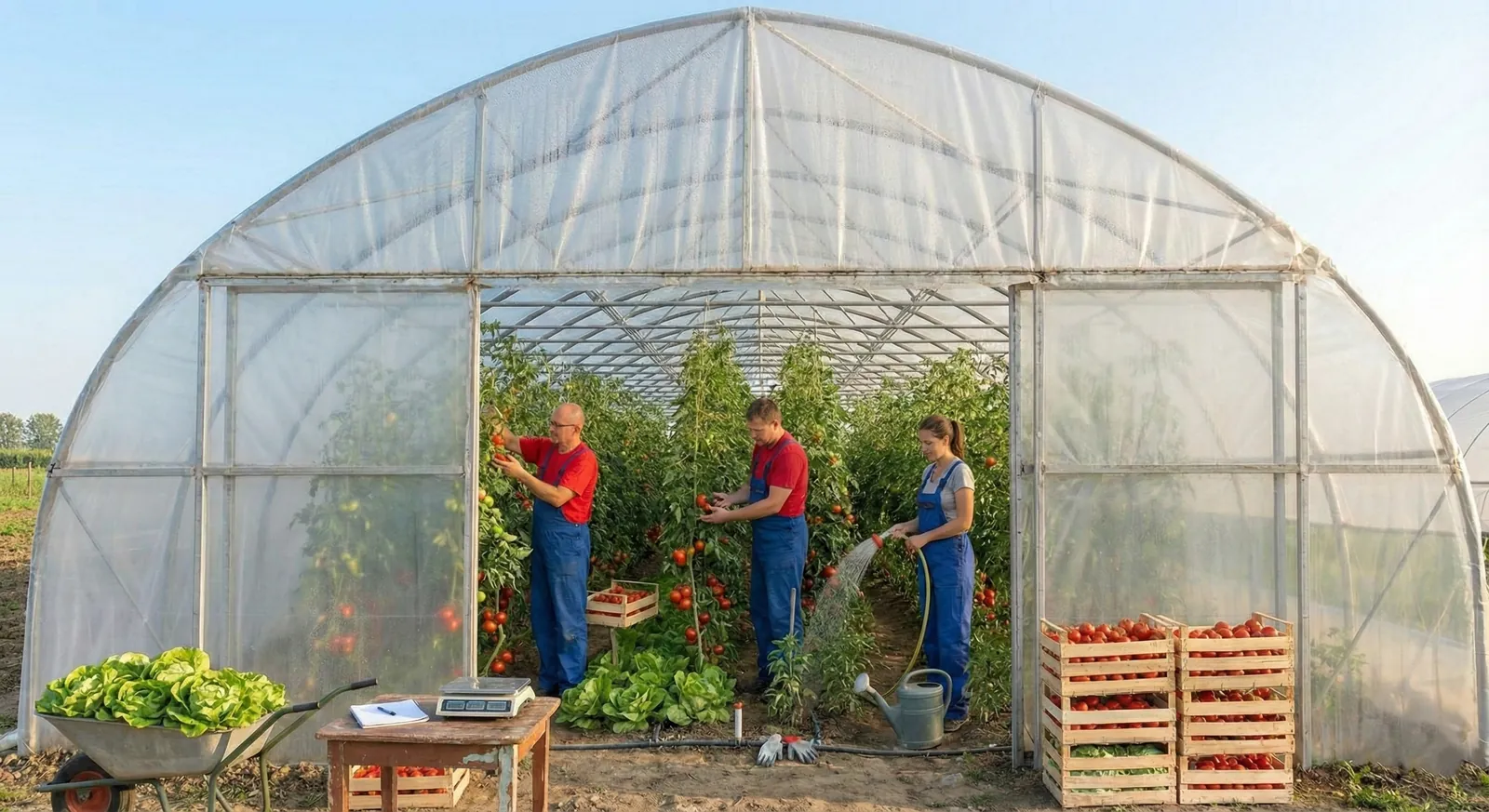
A polyhouse covering is the single most consequential purchase in protected cultivation — it decides light, temperature, disease pressure and your labour bill for the next three to five years. Yet most farmers buy it the way they buy tarpaulin: cheapest rate per square metre. After supplying films to polyhouse projects across Gujarat, Rajasthan and the hills, here is how to think about greenhouse film the way an agronomist would.
Greenhouse Film Pricing in India (2026)
Film is quoted per square metre or per kg. Indicative ex-works Gujarat ranges:
- 120 micron, 1-year UV: ₹13-18 per sqm
- 200 micron, 3-year UV: ₹22-30 per sqm
- 200 micron, 5-year UV: ₹28-38 per sqm
- 250 micron premium (with EVA/IR additives): ₹35-48 per sqm
- Per-kg basis: ₹70-95 per kg depending on additives
A standard 1000 sqm polyhouse at 200 micron 3-year film needs roughly ₹22,000-30,000 of covering material. Against a project cost of ₹6-10 lakh, the covering is small money with outsized impact. Rates exclude 18% GST and freight, and they move with polymer prices — get validity in writing.
The UV Warranty Economics Nobody Explains
Here is the calculation that changes buying decisions. A 1-year film at ₹15/sqm replaced annually over 5 years costs ₹75/sqm plus three replacement labour cycles (a day of pulling film off and on, risking crop damage each time). A 5-year film at ₹33/sqm costs ₹33 over the same period. The "expensive" film is less than half the cost and saves three risky replacement operations. UV stabilisation is the difference between film that yellows and embrittles in one Gujarat summer versus film that survives five.
But check what "5-year warranty" actually means — is it a written warranty from the additive supplier, or a marketing claim? Reputable manufacturers declare the UV package (e.g., HALS-based stabilisation) and back it with written coverage. We specify UV packages matched to Indian light intensity for our greenhouse film range and provide written UV declarations.
Which Micron For Which Structure?
- 120-150 micron: low-cost tunnels, shade houses, seasonal nursery covers
- 200 micron: the Indian polyhouse standard — NHB-approved projects typically specify this
- 250 micron: high-value floriculture, continuous production structures, snow-load regions
Thicker does not automatically mean better light transmission — quality multilayer 200 micron film transmits more PAR light than a cheap thick film. What thickness buys you is mechanical life against wind flutter and hail.
Additives That Justify Their Cost
- Anti-drip (AF): condensation dripping on flowers causes botrytis and petal damage; anti-drip coatings make water sheet instead of drip. Worth it for any flower or fruiting crop.
- IR blocking: keeps night temperatures 2-3°C warmer — meaningful in North Indian winters for gerbera and capsicum
- Anti-dust: reduces the annual transmission loss from dust films — Gujarat and Rajasthan farms see real benefit
- Diffused light: scatters light deeper into the canopy; rose and gerbera growers report visible yield quality improvement
Each additive adds 5-15% to film cost. For a ₹25,000 covering, that is ₹1,500-4,000 for potentially double-digit percentage yield improvements in quality grades. The return is usually obvious, but only if the additives are actually in the film — which brings us to verification.
How to Verify You Got What You Paid For
Film specification is invisible after installation. Protect yourself with these steps: demand a written specification sheet with the quotation; retain a metre of film from every roll with batch marking; for large projects, get a third-party lab test on retained samples for thickness and UV transmission. We also encourage buyers to read why multilayer films outperform single-layer covers — understanding the structure helps you ask better questions.
Installation Mistakes That Kill Film Life
- Over-tightening at installation — film needs seasonal flex, drum-tight covers tear at fixings
- Direct PVC contact with fixings — PVC plasticisers attack PE film; use compatible profiles
- Spray drift from sulphur-based pesticides — sulphur degrades UV stabilisers; never spray directly on film
- Wrong orientation — multilayer films have an inside and outside face; reversed installation kills anti-drip function
Film installed correctly with 3-year UV in a dusty region still benefits from an annual soft-water wash — transmission recovery of 5-10% is common and free.
Frequently Asked Questions
What is the price of 200 micron greenhouse film in India?
Indicative 2026 rates: ₹22-30 per sqm for 3-year UV and ₹28-38 per sqm for 5-year UV, ex-works. Additives like anti-drip and IR add 10-20%. Rates exclude GST and freight.
How long does greenhouse plastic last in India?
UV-stabilised 200 micron film lasts 3-5 years in Indian conditions. Unstabilised poly film degrades within one strong summer. Warranty terms in writing matter more than verbal claims.
Is thicker greenhouse film always better?
No — beyond 200 micron, thickness mainly adds wind and hail resistance. Light transmission depends on film quality and additives, not thickness. Match micron to your structure and weather exposure.
Can greenhouse film be reused after removal?
Practically no for 3+ year films — removal creases and UV history compromise it. Plan replacement dates at purchase and negotiate your next film order in advance; manufacturers reward planned buyers better rates.