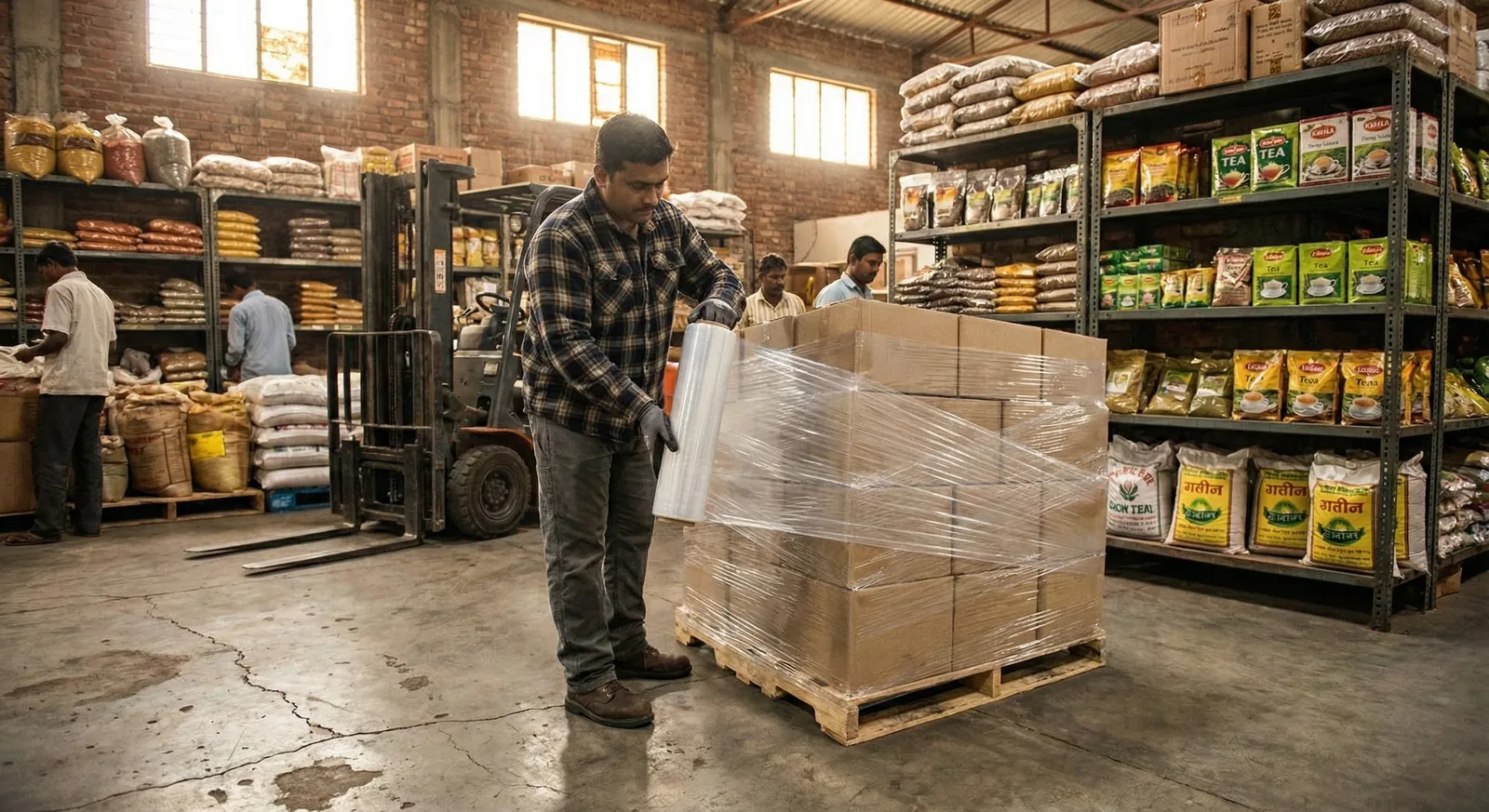
Stretch film is the quietest big line-item in warehouse budgets. A mid-size 3PL wrapping 150 pallets a day can spend ₹8-15 lakh a year on wrap — and most warehouses we audit are running 20-30% more film than their loads need, either from over-spec gauge or from machines running wrong pre-stretch. This guide covers what Indian buyers should actually pay in 2026 and where the real savings hide.
Stretch Film Pricing in India (2026)
Indicative ex-works Gujarat rates for virgin LLDPE stretch film:
- Manual grade 500mm x 17-20 micron (1.5-2 kg rolls): ₹105-135 per kg
- Machine grade 500mm x 23-25 micron: ₹100-130 per kg
- Power pre-stretch machine film: ₹115-150 per kg
- Coloured/opaque security wrap: ₹125-165 per kg
- Mini rolls (100-150mm) for bundling: ₹115-145 per kg
Per-roll maths buyers actually care about: a 2 kg manual roll at ₹120/kg costs ₹240; at 20 micron that is roughly 180-200 metres of usable wrap. Machine rolls run 10-15 kg. Rates exclude 18% GST and freight, and they move with LLDPE prices, so quote validity matters.
Manual vs Machine Grade — The Honest Difference
Manual film is formulated for hand wrapping: slightly higher cling, easier unwind force, shorter rolls that operators can actually handle. Machine film is built to withstand powered pre-stretch — stretch units pull film 150-250% before it touches the load, and only properly formulated film holds its strength after that abuse. The expensive mistake: buying machine-grade film for hand wrapping (operators hate the stiff unwind, wrap quality drops) or manual film into a power pre-stretch unit (film snaps or, worse, wraps weak and loads fail in transit).
Micron Selection Chart by Load Type
- 12-15 micron: light, stable loads up to ~500 kg — cartons on layer pads
- 17-20 micron: standard manual work — mixed pallets up to 800 kg
- 20-23 micron: heavy or irregular loads, sharp-edged cartons
- 23-25 micron machine: the Indian warehouse workhorse for 1-1.5 tonne pallets
- 30+ micron: extreme loads, metal ingots, long-distance sea transit with rehandling
The chart is a starting point — the real test is your worst-case pallet in your worst-case transit. We run trial wraps for buyers of our stretch film range precisely because load profiles differ wildly between a tile manufacturer and a FMCG distributor.
Pre-Stretch Economics — The 20% Saving Nobody Uses
Here is the arithmetic that changes procurement decisions. A stretch wrapper with a 200% pre-stretch carriage turns one metre of film into three metres of wrap. Same pallet, same containment force, one-third the film consumed. Even a modest 150% pre-stretch cuts film use by a third versus hand wrapping. The catch: only films formulated for power pre-stretch hold their integrity after elongation. Buying ₹10/kg cheaper non-pre-stretch film for a pre-stretch machine is paying less per kg to consume 40% more kg.
Hand operations save differently: train wrappers on the overlap-and-hook technique and enforce consistent tension. Two operators wrapping the same pallet can differ 30% in film consumption — operator training is the cheapest film-saving intervention in warehousing.
Containment Force — The Spec That Matters More Than Micron
Containment force (how hard the wrap squeezes the load) is what actually prevents load failure. More layers of thinner film at correct tension often outperform fewer layers of thick film. When pallets fail in transit, the reflex is to buy thicker film; the right fix is usually containment force measurement and wrap pattern adjustment. We wrote a deeper operational guide in how to calculate the right gauge and cut packaging costs by 20% — worth reading before your next indent.
Storage and Handling for Indian Warehouses
Stretch film stored through a Delhi summer or a Mumbai monsoon degrades — edges telescope, unwind gets erratic. Store rolls flat, in cool covered areas, away from dock doors where thermal cycling is worst. Use oldest stock first, and never drop rolls — even a dropped-on-edge roll wraps inconsistently from that point. Cheap habits, expensive consequences.
Frequently Asked Questions
What is the price of stretch film per kg in India?
Indicative 2026: ₹100-135 per kg for virgin LLDPE in manual and machine grades, ex-works. Pre-stretch and coloured variants run higher. A 2 kg manual roll costs roughly ₹210-270.
Which micron stretch film should I use for pallets?
Standard 1-tonne stable pallets: 17-23 micron. Irregular or heavy loads: 23-25+ micron machine grade. Light carton pallets can drop to 12-15 micron. Trial wraps on your worst pallet settle it definitively.
How many pallets does one machine roll of stretch film wrap?
A 12 kg machine roll at 23 micron with 150-200% pre-stretch typically wraps 40-70 standard pallets depending on load height and wrap pattern. Hand rolls cover far fewer — roughly 8-15 pallets per 2 kg roll.
Why is my stretch film breaking during wrapping?
Usually wrong film-to-machine match (manual film in pre-stretch units), stored-degraded film, or brake tension set too aggressive. Check storage conditions and machine settings before blaming film quality.