Ask any forest department officer or CSR plantation manager what kills saplings in year one. It is not drought — it is cattle, nilgai and goats. A ₹45 tree guard protecting a ₹150 sapling plus two years of watering labour is the highest-ROI purchase in Indian plantation work, yet buying it wrong (wrong height, flimsy mesh, delivered flat and unusable) wastes entire plantation budgets. This guide covers the specification details that matter for buyers of our plastic tree guard range.
Tree Guard Pricing in India (2026)
Indicative ex-works rates by height (HDPE/PP mesh construction):
- 2 feet (60cm) — ornamental and urban use: ₹35-55 per piece
- 3 feet (90cm) — the plantation standard: ₹45-70 per piece
- 4 feet (120cm) — cattle pressure zones: ₹65-95 per piece
- 5 feet (150cm) — heavy wildlife pressure (nilgai, deer): ₹90-130 per piece
Rates exclude 18% GST and freight. Bulk orders above 10,000 pieces earn meaningful discounts — this product's economics are almost entirely volume-driven, which is why departmental and CSR aggregators buy annual framework quantities rather than plantation-by-plantation.
Height Selection — Match the Threat, Not the Catalogue
The honest mapping from field experience: goats clear 2.5 feet easily and 3 feet reluctantly; cattle browse up to about 4 feet depending on animal size; nilgai and deer reach 4.5-5 feet on hind legs. Urban roadside plantings with only human threats manage with 2-2.5 feet. Buying 3-foot guards for nilgai territory is donating plastic to wildlife — the browse line tells you within weeks. Survey the actual browsing pressure at your plantation site before specifying height; it varies dramatically across districts.
Mesh Type and Structural Details That Matter
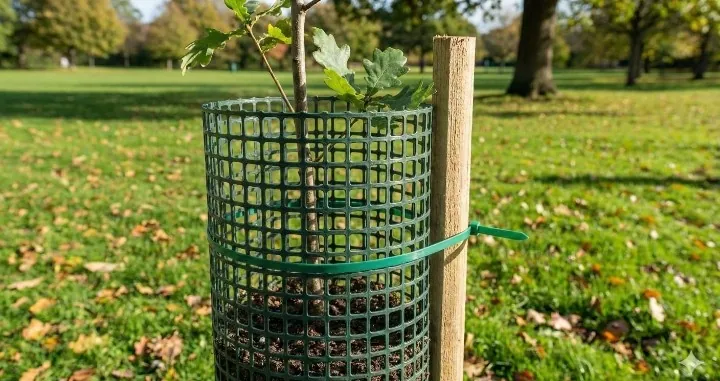
- Hexagonal mesh: the standard — flexible, economical, adequate ventilation for sapling growth
- Diamond mesh: slightly more rigid construction for windy sites
- UV stabilisation: absolutely mandatory — tree guards live in full sun for 3-5 years; unstabilised plastic embrittles within one summer and shatters when cattle lean on it
- Edge finishing: rolled or extruded edges prevent the sharp-edge cuts that injure plantation workers during installation
- Flat-pack design: guards that ship flat and clip into cylinders slash transport costs — a 40ft container carries several times more flat-packed units
UV stabilisation deserves emphasis because it is invisible at purchase and fatal in year two. Get the UV declaration in writing with the supply spec — this is the single most common quality dispute in government supply.
Bulk Supply for Government and CSR Projects
Departmental purchases run through tender specifications, and the failures we see are procedural: specs that omit UV stabilisation language, deliveries judged by piece count not mesh integrity, and no sampling protocol at receipt. A robust tender spec includes: UV stabilised virgin HDPE/PP, mesh dimensions, height tolerance, edge finishing requirement, and flat-pack clipping integrity test. At delivery, sample 1% of consignment — clip-test assembly and flex-test the mesh. Our supply operation for plantation protection products follows documented batch QC precisely because departmental audits ask for it.
Installation Discipline — Where Guards Get Wasted
- Anchor properly: guard must be planted 5-8cm into soil and secured with stakes or wire ties; loose guards become wind-blown litter within a season
- Clear the collar zone: weeds inside the guard outgrow the sapling — guards protect stems, not compete with them
- Right diameter: guard diameter must allow 2-3 seasons of girth growth; saplings outgrowing their guard get girdled by their own protection
- Retrieve and reuse: after 3-4 seasons, guards come off intact and move to new plantations — plan retrieval, guard reuse cuts per-plantation cost 30-40%
That last point changes budget arithmetic: a ₹60 guard used across two plantations costs ₹30 per plantation cycle. Departments that institutionalise retrieval run materially cheaper programmes.
Frequently Asked Questions
What is the price of a plastic tree guard in India?
Indicative 2026: ₹35-55 for 2 feet, ₹45-70 for the standard 3 feet, ₹65-95 for 4 feet, per piece ex-works. Volume above 10,000 pieces earns substantial discounts. Rates exclude GST and freight.
What height tree guard should I buy?
Match the browsing threat: 3 feet for goats and general plantation, 4 feet for cattle zones, 5 feet for nilgai/deer pressure. Urban plantings with only human threats manage at 2-2.5 feet.
Do tree guards need UV stabilisation?
Yes — guards live in full sun for years. Unstabilised plastic embrittles within one summer and shatters under animal pressure. Get UV stabilisation written into the supply specification.
Can tree guards be reused?
Yes — quality guards survive 3-4 seasons and transfer to new plantations intact. Plan retrieval at plantation design stage; reuse cuts per-cycle cost by 30-40%.