Talk to a tomato farmer in Nashik who has used silver-black mulch for three seasons and ask if they would go back to bare ground cultivation. The answer is always no — usually with a laugh. Weed control alone pays for the film, but the real money is in earlier harvests, cleaner fruit and 30-40% water savings through the drip line underneath. This guide is the field-level version of what we discuss with farmers buying our mulch film range at Kalol.
Why Silver-Black Is the Indian Standard
The colour combination is not cosmetic. The black underside blocks all light — no photosynthesis, no weeds. The silver top surface reflects sunlight back into the plant canopy and confuses flying pests like aphids and whitefly, which orient by light. Reflection also reduces soil temperature in the root zone by several degrees — critical in Indian summers where bare soil surface can hit 45°C+ and cook young roots. Plain black film does the weed and moisture job but heats the bed; transparent film warms soil for winter crops but grows weeds underneath. Silver-black covers the most bases for most Indian conditions.
Sizes, Thickness and Per-Acre Quantity
Mulch film in India runs 20-100 micron, with 25-30 micron being the vegetable-farming workhorse. Widths of 0.9m to 1.2m cover standard raised beds. Rough per-acre quantities (assuming 60-65% bed coverage with rest being walkways):
- 1 acre vegetable crop, 1.2m width, 25 micron: roughly 3,200-4,000 sqm of film
- Per-kg pricing at ₹100-135/kg works out to ₹10,000-16,000 per acre for 25-30 micron
- 50 micron (two-season use): ₹18,000-26,000 per acre but covers two crops
Rates are indicative ex-works, exclude 18% GST and freight, and move with polymer prices. UV stabilisation matters enormously — non-UV film embrittles in one summer; properly stabilised 25-30 micron film lasts a full season reliably, and 50 micron versions survive two seasons.
Thickness Decision: One Season vs Two
The honest maths: 25 micron used for one season vs 50 micron used for two. Two-season 50 micron is cheaper per season and saves one laying labour cycle — but only if you actually get two clean seasons from it. Short-duration crops (marigold, leafy vegetables) followed by a second crop make 50 micron sensible. Long-duration crops (tomato, watermelon) that stress film through staking and foot traffic often justify fresh 25 micron each season. There is no universal answer; there is your rotation answer.
Laying Right — Where Most Money Is Lost
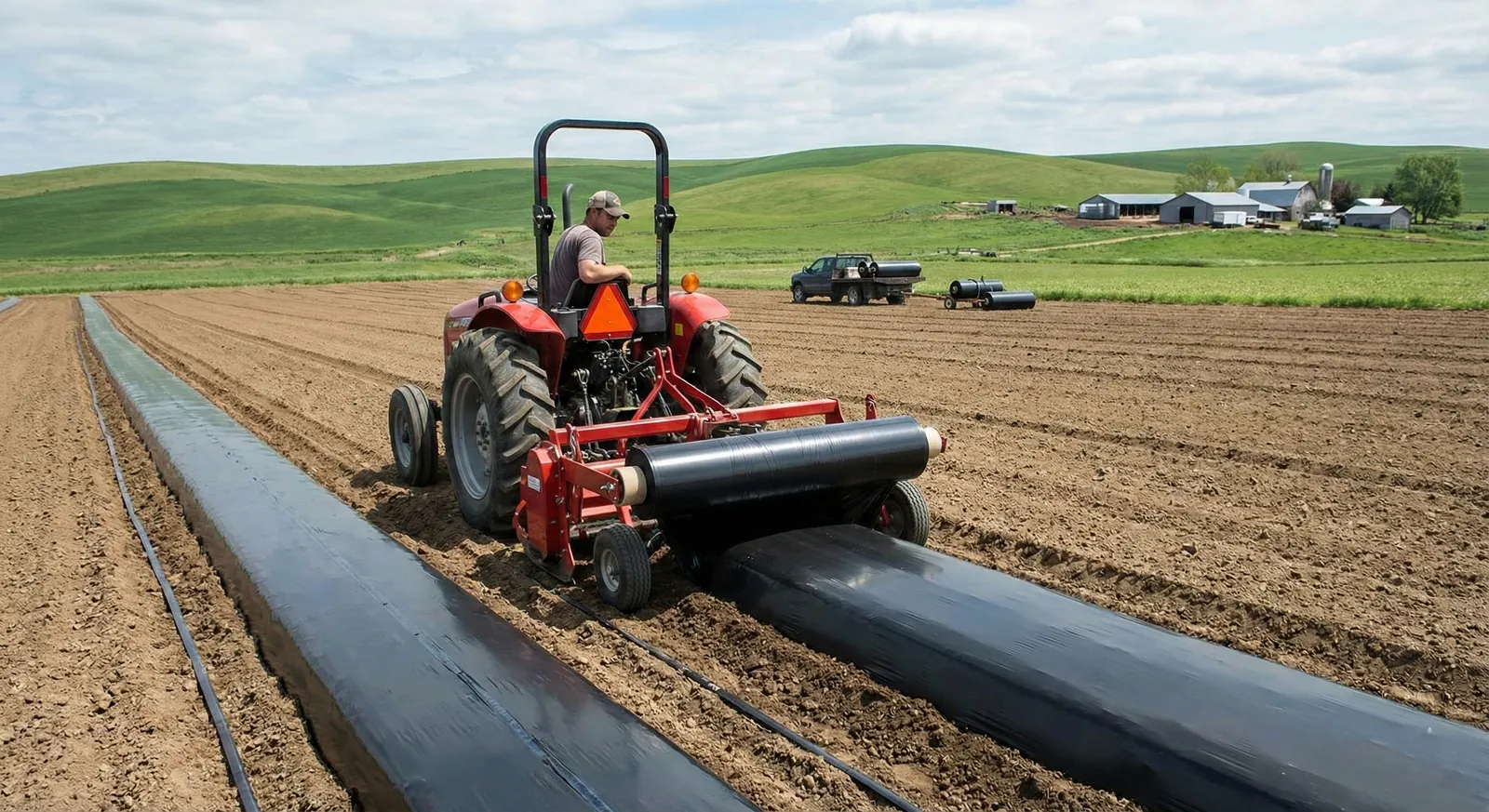
Film laid badly underperforms regardless of quality. The field mistakes we see repeatedly:
- Loose laying: wind lifts film, tears start at fixing points. Film should sit taut, in contact with the bed surface
- Wrong side up: sounds absurd, happens constantly — silver must face the sky. Mark rolls and brief the laying crew
- No drip line integration check: lay drip, test for uniform emission BEFORE covering; fixing blocked emitters under mulch later means tearing your own film
- Planting holes too big: large cuts expose soil, invite weeds exactly where moisture is highest — cut minimal holes, use the heated-ring technique for clean cuts
- Edge anchoring shortcuts: bury edges 10-15cm in firm soil; surface-pinned edges lift in the first pre-monsoon blow
We cover installation in more detail in our mulch film water conservation guide — including bed preparation that makes film laying dramatically easier.
Crop-Wise Notes From Indian Fields
- Tomato/chilli/capsicum: the classic silver-black wins — pest reflection plus fruit cleanliness, with staking care near film
- Watermelon/muskmelon: wider beds 1.2m+, 30 micron for vine traffic abrasion
- Strawberry (Mahabaleshwar and hill belts): silver-black is near-universal — fruit sits on film, no mud splash
- Marigold/flowers: 25 micron sufficient for short cycles
- Okra/leafy: works well, watch summer soil temp under black in extreme heat — silver surface earns its cost here
Disposal and the Plastic Responsibility
Used mulch film must be cleared after harvest — leaving shredded plastic in soil is both an environmental and a soil-health liability. Clean film has scrap value: agri film buyers pay for reasonably clean used mulch, offsetting 10-20% of your film cost. Plan retrieval with the same seriousness as laying; a team that pulls film in one afternoon saves weeks of soil contamination later. For plastic-mulch-plus-ground-cover combinations in orchards, see our advanced farming overview.
Frequently Asked Questions
What is the cost of mulch film per acre in India?
Indicative 2026: ₹10,000-16,000 per acre for 25-30 micron single-season film, ₹18,000-26,000 for 50 micron two-season grade. Rates exclude GST and freight and vary with polymer prices.
Which colour mulch film is best for vegetables?
Silver-black is the all-round winner for most Indian vegetable crops — weed control from the black underside, pest confusion and soil cooling from the silver top. Plain black suits winter crops where soil warming helps.
How long does mulch film last?
UV-stabilised 25-30 micron lasts one full crop season reliably; 50 micron versions run two seasons. Non-UV film degrades within weeks of strong sun — always confirm UV stabilisation in writing.
Can I lay mulch film without a machine?
Yes for small plots — a two-person team with bed-shaping and edge-burying discipline can do 15-20 gunta per day. For acre-scale operations, hand laying costs more in labour than a mulch layer attachment pays back.