
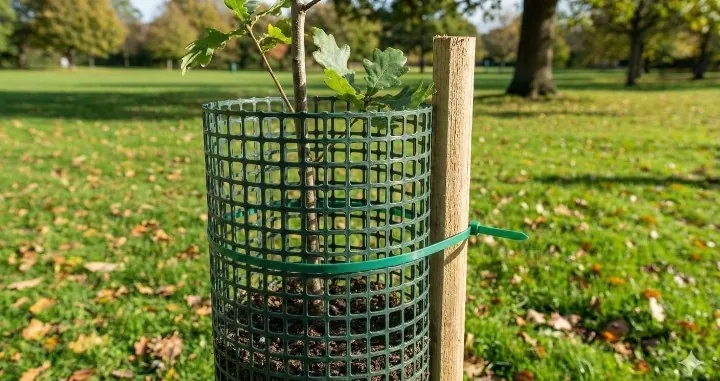
Australia plants trees through institutions most countries do not have: Landcare groups, council revegetation programmes, catchment authorities and the continuing bushfire-recovery plantings that followed the black summer fires. Every one of those programmes protects its seedlings, and the plastic tree guard is the unit of that protection. The Australian checklist for guards has three parts — the sun, the wildlife and the border — and getting all three right is what separates a working guard from a worthless one.
The sun: UV built for the southern hemisphere
The Australian sun photodegrades unstabilised plastic faster than almost anywhere — a generic guard fails within one summer, and a guard that fails in year one abandons the seedling at its most vulnerable stage. Multi-season service requires UV stabilisation built into the material and validated for southern-hemisphere irradiance, and that validation is the first line of any serious Australian guard specification. Mesh guards dominate revegetation volume — ventilated PP or HDPE tube mesh, 25 to 60 centimetres tall — because seedlings in the Australian climate need air movement; solid corrugated guards with slots serve urban and streetscape planting where equipment and vandalism are the threats.
The wildlife: guards that suit the browsing threat
Australian revegetation guards against kangaroos, wallabies, wombats, rabbits and hares — and the guard construction follows the threat. Low, wide mesh guards suit small mammal browsing around community plantings; taller 60 to 75 centimetre mesh suits wallaby pressure; solid guards suit streetscapes. The detail Australian programmes check is animal-safe design — no sharp edges at seedling height, mesh openings that do not trap birds and lizards — because a guard that harms the wildlife it coexists with fails the programme's own standards. We manufacture to those requirements and state the construction per specification.
The border: DAFF, duty and GST
DAFF biosecurity applies as to every Australian consignment: clean bale packing, the packing declaration and container cleanliness statement ship with each order as standard, with loaded-container photographs for the file. Duty on plastic articles runs low to nil on the general rate under the relevant headings (your broker confirms the line), with AI-ECTA preferential access available on many Indian lines when a certificate of origin is filed; 10% GST applies on landed value and is creditable. Transit from Mundra to Melbourne runs 25 to 35 days, and programme volumes confirm one to two cycles ahead of planting windows — Australian planting seasons wait for no container.
Frequently Asked Questions
What UV life do Australian guards need?
Multi-season stabilisation validated for southern-hemisphere sun — generic guards fail within one Australian summer.
Which guard suits wallaby pressure?
Taller 60 to 75 centimetre ventilated mesh with animal-safe openings — no sharp edges, no trapping geometry, built for the browsing threat.
What DAFF documents arrive with the shipment?
Packing declaration, container cleanliness statement and standard trade documents, issued with every consignment so clearance runs on schedule.
What duty applies from India?
Low to nil on the general rate for plastic articles (broker confirms the line), with AI-ECTA preferential treatment available on many Indian lines with a certificate of origin; 10% GST is creditable.
Guard specifications are on the Plastic Tree Guard page. For the UV strategy read the UV stabilisation guide, and for other Australian import lines see the ground cover import guide.