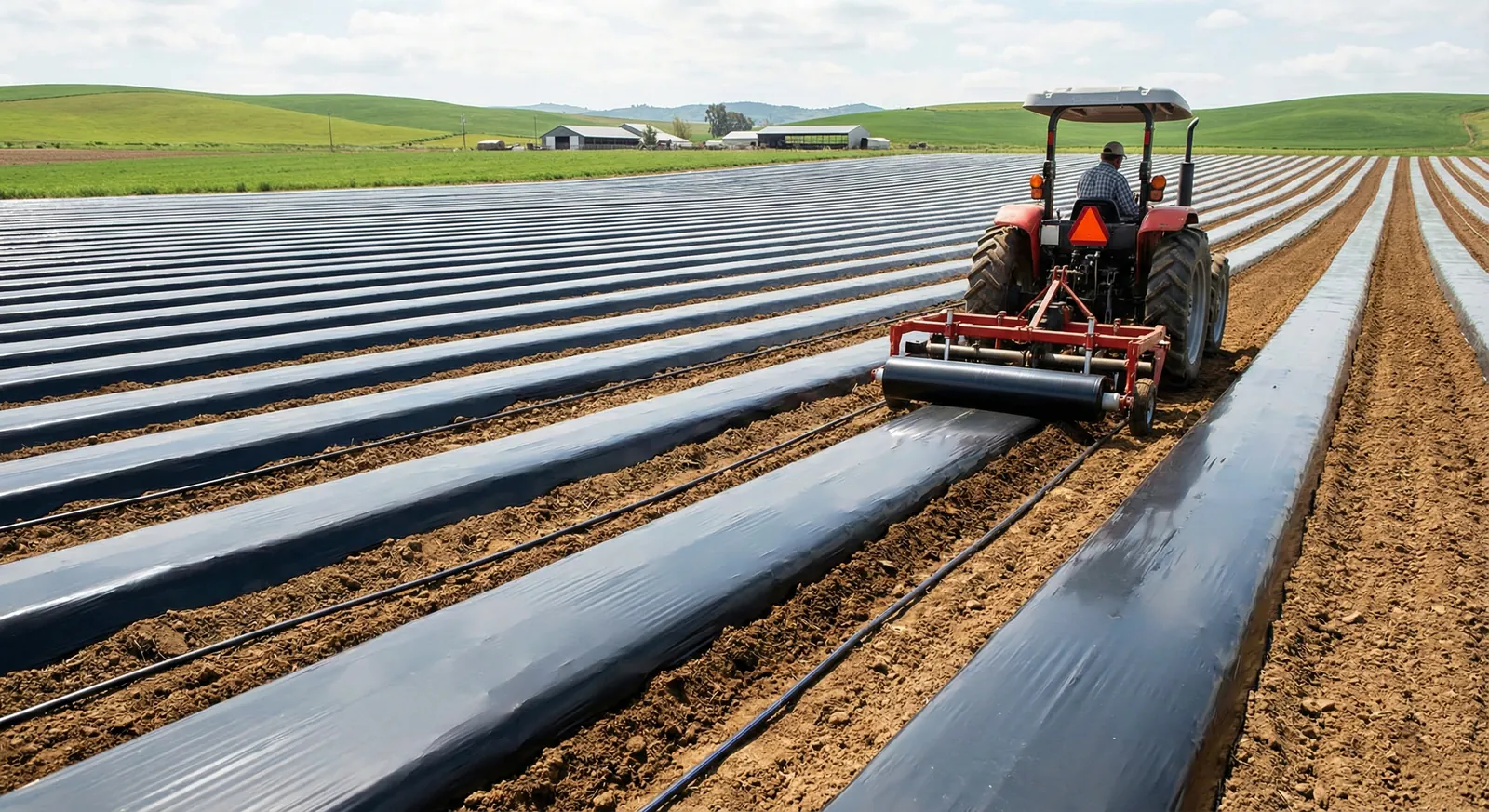
Germany's most distinctive mulch film story is not a vegetable row at all — it is the Spargel fields. White asparagus, the country's obsession, grows under embankments of black-and-white foil, and the asparagus sector buys film by the container load every spring. Add open-field vegetables, strawberry beds and strawberry-on-film systems, and Germany is one of Europe's most consistent mulch film markets. Importing into it has three German specifics worth mastering: the standards landscape, the tax mechanics and the timing against the asparagus season.
What German buyers spec
Asparagus foil runs wider and heavier than row-crop mulch — 1.6 to 2.0 metre black-white film in the 50 to 100 micron range, engineered to sit on ridges for a full season of machine traffic. Conventional row-crop mulch runs 20 to 40 micron in black, clear or photo-degradable variants for vegetables and strawberries. The standards conversation in Germany increasingly splits two ways: conventional PE film where disposal is managed through collection systems, and certified biodegradable mulch film to EN 17033 for operations where lifting and disposal are impractical. We supply both — and we supply the EN 17033 test documentation with biodegradable orders, because German buyers verify the certificate, not the claim.
Duty, VAT and the import mechanics
Polyethylene film under HS 3920.10 carries a low single-digit MFN duty into the EU — your broker confirms the current TARIC line for the exact construction. The bigger cashflow number is import VAT at 19%, payable at entry and recoverable through the VAT return for registered importers; most German agricultural distributors run this cleanly through their tax cycle. EORI registration, the commercial invoice, packing list, bill of lading and certificate of origin complete the standard set. Containers reach Hamburg or Bremerhaven from Mundra in roughly 25 to 35 days, with inland barge and rail distribution reaching Bavaria and the asparagus regions of Lower Saxony and Baden-Württemberg without drama.
Timing against the German season
The asparagus calendar is brutal: foil goes on ridges in early spring, and distributors who miss the window hold stock for a year. The working pattern we see: orders confirmed by autumn, production in winter, containers landing January to February, warehouse distribution before the first warming weeks. Vegetable programmes spread across the season but still reward one-cycle-early ordering. We hold production capacity for German autumn bookings precisely because a film order that arrives late is not a discount opportunity — it is a lost season.
Frequently Asked Questions
Which standard applies to biodegradable mulch in Germany?
EN 17033 is the European biodegradable mulch film standard — we supply test documentation with certified product, and German buyers can verify with the certificate body directly.
What duty and VAT apply?
A low single-digit MFN duty under HS 3920.10 (your broker confirms the TARIC line) plus 19% import VAT, recoverable through the VAT return for registered businesses.
Can you match asparagus foil specifications?
Yes — wide black-white constructions in 50 to 100 micron with season-length UV packages; send the spec or a sample and we counter-sample before production.
When should we order for the asparagus season?
Confirm by autumn for January-February arrival: production plus ocean runs 8 to 10 weeks, and the inland leg to southern Germany adds days, not weeks.
Film specifications are on the Mulch Film page. For biodegradable trends in Europe read the European ground cover guide, and for import mechanics on woven agriculture products see the South Africa import guide.