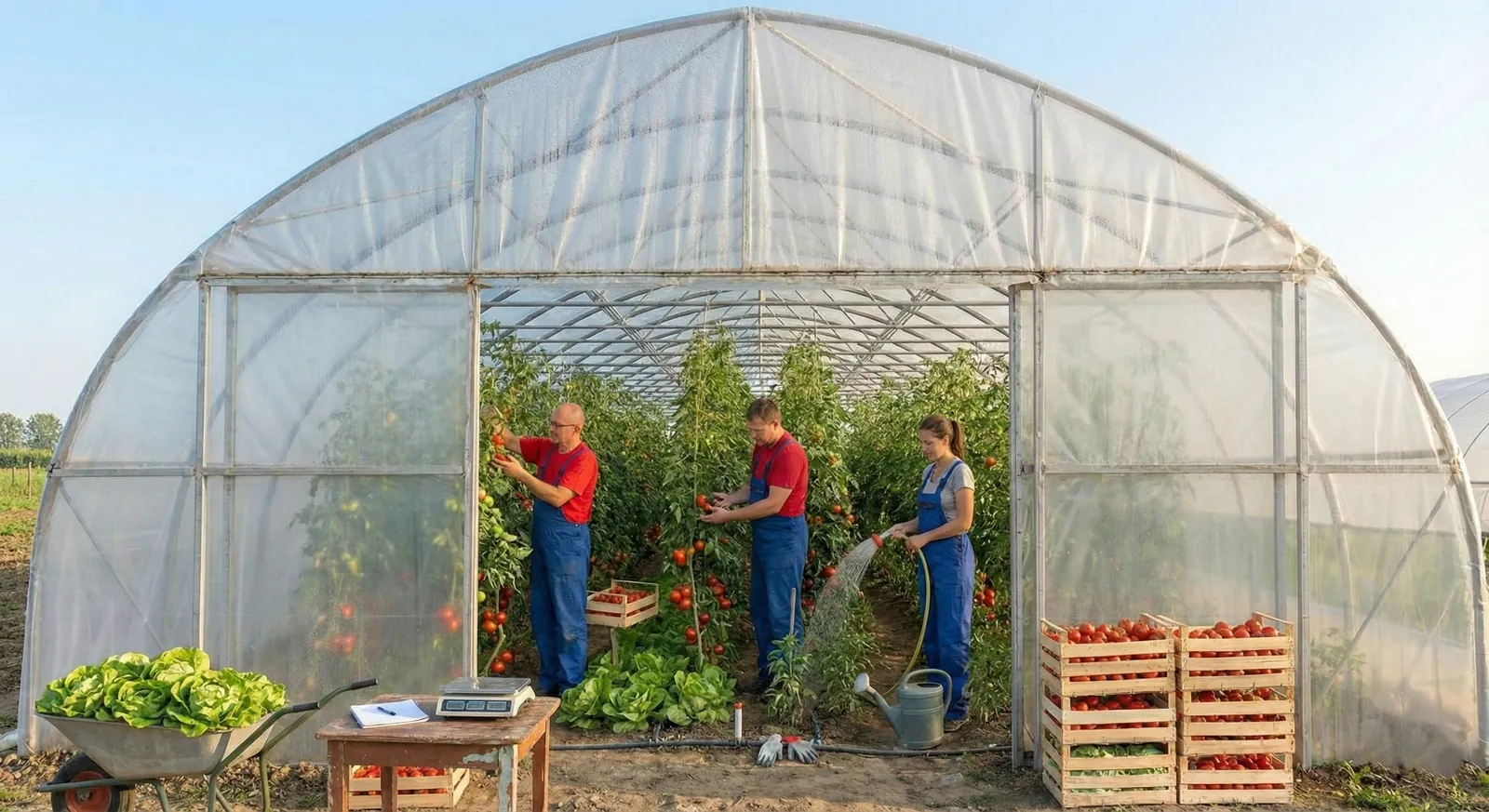
A greenhouse cover is a four-year decision wearing the price tag of a one-season product. The film that costs ten percent more but carries a written UV warranty, IR thermal additive and anti-drip surface typically repays the difference in one winter - warmer nights, drier canopies, fewer disease hours. This guide lays out how covering film is specified at the manufacturing end, so growers and importers buy on parameters instead of promises.
Greenhouse Film Specifications That Matter
- Thickness: 120-200 micron. Lighter 120-150 micron suits low-wind polytunnels; 180-200 micron is the standard for full-scale greenhouses and exposed sites.
- Construction: three-layer co-extrusion - outer UV-stabilised, middle IR-thermal for night warmth, inner anti-drip to stop condensation drip onto canopies.
- UV warranty: 3-year and 4-year packages, quoted in writing against regional light intensity - desert markets need the heavy package, not the default.
- Widths: webs to cover straight runs without taping; standard 4-8 metre widths with wider production on request.
- Light transmission: diffused versus clear variants - diffusion spreads light into lower canopy layers and softens leaf scorch.
Available structures and warranty options are on our greenhouse film product page, with additive roles explained in our multilayer film guide.
Where Covering Film Is Specified
- Vegetable greenhouses: tomato, capsicum and cucumber ranges where night temperature decides winter yield.
- Floriculture and nurseries: propagation houses needing clean light and drip control.
- Polytunnels: low-cost protected cultivation, often 120-150 micron with 3-year UV.
- High-rainfall belts: anti-drip inner layers keep fungal pressure down through monsoon cycles - the irrigation interplay is in our price and spec guide.
Manufacturing and Quality Control
We co-extrude covering film in-house on three-layer lines with UV, IR and anti-drip additives metered in the melt stream, not coated afterwards. Each batch is tested for thickness profile, tensile in both directions, light transmission and UV dosage against the declared warranty. Rolls are checked for gauge bands and wound on strong cores for mechanised covering. Export orders carry a specification sheet and warranty letter - the paperwork structure builders and insurers ask to see.
How to Specify Your Order
Fix five things: structure span and length, wind exposure, micron and UV package, clear or diffused light, and fitting method (grooves, clips or battening). MOQ starts at pallet level for growers; distributors run container programs with mixed widths. Lead time is typically 2-3 weeks. Desert and high-altitude buyers should state regional conditions explicitly so the UV package matches - a European warranty letter does not survive Gulf light intensity unchanged.
Frequently Asked Questions
Is 200 micron film always the right choice?
Not always - 120-150 micron with proper UV is correct for tunnels and calm sites; 180-200 micron earns its cost on large spans and wind-exposed structures.
What does the IR additive actually do?
It reflects outgoing long-wave heat back into the house at night, lifting night temperatures a few degrees - the difference shows up directly in winter production.
How is UV warranty documented?
As a written warranty letter stating years and coverage region, tied to batch production records; replacements are assessed against those documents, not verbal assurances.
Siddhii Global co-extrudes greenhouse film at its Kalol, Ahmedabad plant for growers, structure builders and distributors across Asia, Africa and the Gulf. Send your structure dimensions and climate and we will quote film with the warranty letter included.