American wholesale buyers talk about trash bags in gauge, not microns, and they talk about cost per bag, not cost per case. Once you understand those two habits, sourcing heavy duty garbage bags from India becomes a straightforward exercise in arithmetic. We ship contractor-grade and municipal-grade bags to US janitorial distributors and waste-services companies from our Gujarat plant, and this guide collects the numbers that decide whether the landed cost beats domestic supply.
The product ladder US distributors buy
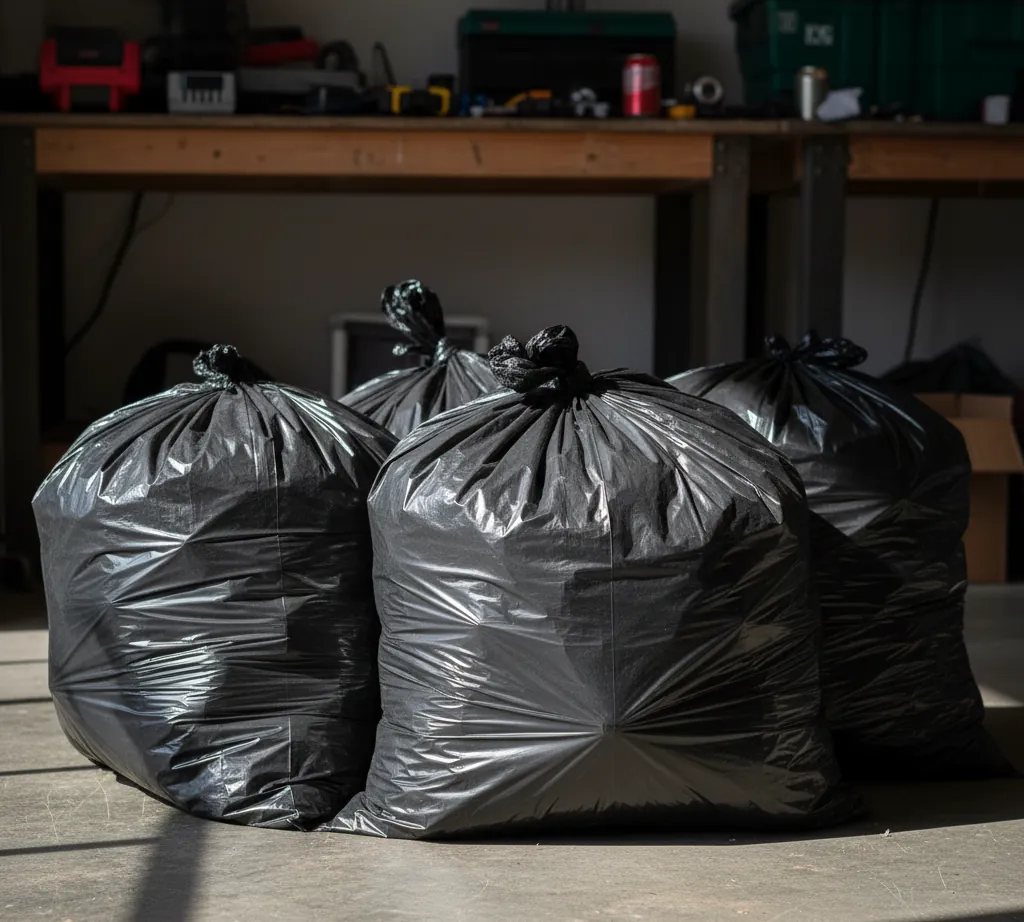
At the top sit 55-60 gallon contractor bags, 40 by 46 inches and larger, running 1.5 to 2.0 mil — the black bags landscape crews and restoration contractors burn through. Below that, 40-45 gallon commercial liners around 1.1-1.5 mil serve offices and schools, and 30-33 gallon kitchen liners in 0.8-1.0 mil round out the volume. Star-seal bottoms outsell flat-seal in every US category we ship because they resist the "point load" split when a bag of wet debris hits concrete. Coreless rolls dominate case packs — typically 25 bags per roll, 8-12 rolls per case — because they feed fast from janitorial carts. For food-contact adjacent uses like cafeteria liners, we run FDA-compliant resins under 21 CFR 177.1520 so the film tests clean for indirect food contact.
The duty stack, line by line
Polyethylene sacks and bags classify under HTS 3923.21 with a Column 1 general rate of 3%. On top sit the Merchandise Processing Fee and Harbor Maintenance Fee for vessel arrivals, and — this is the line that changed in 2026 — a Section 301 additional duty applying to a long list of economies including India, in force since July 2026. Budget roughly 10% extra on Indian-origin bags and confirm the live rate with your customs broker before you quote landed cost to your customers; the base rate alone will under-budget the entry. Goods from several rival origins carry the same surcharge or worse, which is partly why India remains competitive in this category. Your broker files ISF 10+2 before loading — we supply the commercial invoice, packing list and mill certificate the same week production closes.
Container math: why FCL wins
A 40ft high cube swallows around 20-24 pallets of cased bags, 18-22 tonnes depending on the size mix. At that scale, per-bag landed cost typically undercuts LCL by 20-30% and domestic spot buying by more. LCL makes sense for a first trial order — 3-5 pallets through a consolidator into NY-NJ or Savannah — but the moment a distributor has standing demand, FCL pays. East Coast transit from Mundra runs 28-35 days to NY-NJ or Savannah; Houston suits Gulf distributors; LA/Long Beach works for the West Coast though the port-to-warehouse leg is longer. Plan production at 7-10 days and add 2-4 days for customs release.
For the technical side of gauge selection, our gauge comparison guide for US buyers covers film thickness logic, and our contractor-grade trash bag breakdown explains why 1.5 mil bags fail when cheap film gets resold as heavy duty. The full product range sits on our heavy duty garbage bags page.
Frequently Asked Questions
What does duty actually add to my landed cost?
Base 3% on HTS 3923.21, plus MPF and HMF fees, plus the Section 301 additional duty on Indian-origin goods (roughly 10% since July 2026). Your broker confirms the live stack; we recommend quoting landed cost with 13-14% duty-related overhead until you see real entries.
Can I mix sizes in one container?
Yes — most US distributors split a 40ft HC across three to five SKUs, typically 60-gallon contractor bags, 40-45 gallon liners and one roll format. Each SKU keeps its own case count on the packing list.
Do you test film before shipment?
Tensile to ASTM D882, impact by dart drop to ASTM D1709, tear to ASTM D1922 — certificates ship with the documents set. We also run drop tests on loaded cases before container stuffing.
Is private label available for US distribution?
Yes — printed rolls, branded cases, UPC-labelled cartons. Flexo printing handles up to four colours; allow five working days for artwork approval before the production slot.