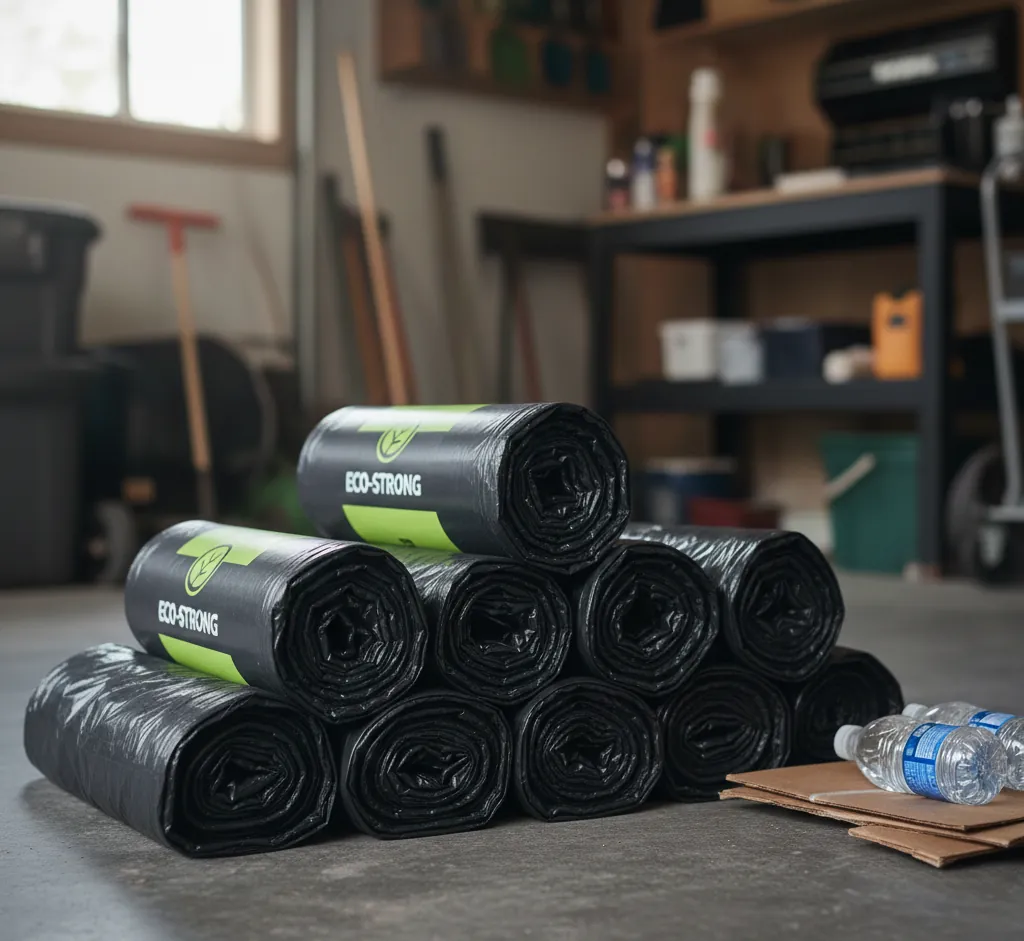
France buys trash bags in two very different moods: the precision of a starred restaurant kitchen and the brute volume of a municipal contract. Distributors who serve both — the CHR sector (cafés, hotels, restaurants) on one side, collectivités and facility management on the other — need a supplier who can hold gauge and colour consistency across wildly different order patterns. We manufacture trash bags and rolls in Gujarat for exactly this dual market, and the applications below map where the volume actually sits.
CHR: the highest-frequency customer in France
Hotels and restaurants replace bin liners multiple times a day, every day — a mid-size Paris hotel burns through thousands of 20-30L bags a month across rooms, kitchens and back offices. The CHR channel buys on roll format (coreless for speed), consistent perforation (no mid-service splits), and compact case counts that fit a cellar. Kitchens add grease and puncture demands — 30-40 micron in 30x37 inch and up, with a strong bottom seal. Restaurant groups and hotel chains increasingly run tender-based purchasing, which means consistent quality across repeated container orders matters more than a one-time low price. Our colour segregation guide applies directly here, since French kitchens run bio-waste streams (food waste sorting is now standard practice) alongside general waste and recyclables.
Collectivités, FM and the events economy
Municipal contractors and facilities managers buy the heavy end: 120L and 240L liners at 50-80 micron for public buildings, schools, and street bins; transparent bags where security screening applies (stations, stadiums, large events — and France stages more large events than almost anywhere). The events segment is worth naming separately: festivals, exhibitions and city celebrations consume container quantities of clear and coloured liners on unpredictable schedules, and distributors who can flex production windows win that business. For kerbside outdoor sacks, EN 13592 is the referenced standard. On the regulatory side, France's AGEC law (anti-waste for a circular economy, 2020) and its Triman/Info-tri sorting labelling rules affect how packaging products are labelled at retail — relevant when you place consumer-format packs on French shelves, less so for commercial master cases. As importer you also carry EPR packaging obligations; we supply per-case weights for your declaration.
Route and paperwork
Mundra to Le Havre runs 24-30 days port to port; Marseille/Fos serves the south. EU duty on HS 3923.21 per the TARIC line plus 20% French import VAT at clearance. Production 7-10 days; plan five to six weeks PO to door. French-language case print for private label is routine on our flexo line.
Formats and sizes sit on our trash bags and rolls page, the heavy municipal range on our heavy duty garbage bags page, and the refuse-sack standard is explained in our EN 13592 Europe guide.
Frequently Asked Questions
Which sizes does the French CHR channel buy most?
20x30 inch and 24x32 inch in 15-25 micron for rooms and offices; 30x37 inch at 30-40 micron for kitchens; 60L-120L liners for bar and service areas. Coreless rolls dominate.
Do AGEC and Triman rules affect my import?
They affect retail-format packaging labelling in France; commercial master cases are largely unaffected. If you plan consumer packs, your French EPR and labelling advisor confirms the Triman/Info-tri artwork needs — we print to the approved file.
What is the duty and VAT at entry?
The EU conventional rate for the HS 3923.21 TARIC line plus 20% French import VAT, recoverable through your VAT process. Your broker confirms the live line rate.
Can you supply transparent bags for events and stations?
Yes — clear film in the same gauge range as black, on rolls or boxed, with consistent optical clarity for screening points. Events buyers typically take mixed containers of clear, black and coloured SKUs.