In heavy-duty industries like chemical processing, wastewater treatment, and metal fabrication, choosing the right thermoplastic sheet is critical. A single chemical spill or a high-impact collision can destroy equipment, halt production, and cause catastrophic safety hazards.
Two of the most dominant materials used for industrial lining and engineering parts are Polypropylene (PP) Sheets and High-Density Polyethylene (HDPE) Sheets. While both are highly durable, they perform differently under stress, temperature, and chemical exposure. So, how do procurement engineers choose the right one? Let’s break it down.
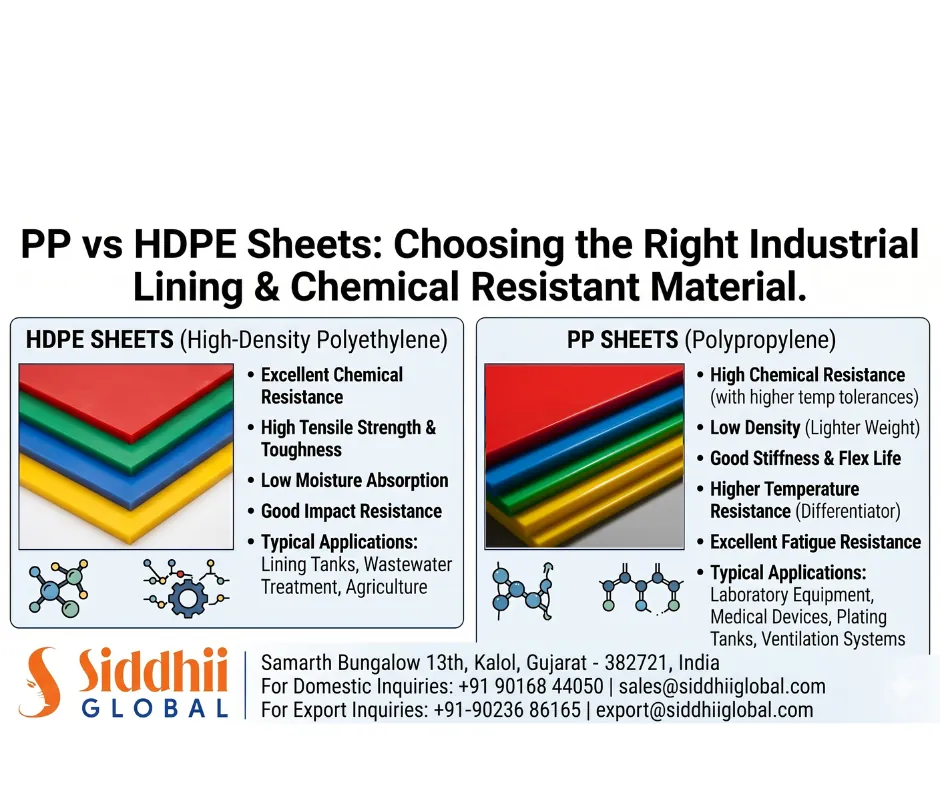
PP vs HDPE Sheets: What’s the Difference?
Both are thermoplastic polymers, but their molecular structures make them suitable for completely different industrial applications.
Polypropylene (PP) Sheets
PP sheets are known for their stiffness and high-temperature tolerance.
Higher Melting Point: PP can withstand higher temperatures, making it ideal for transporting hot liquids or gases.
Chemical Resistance: Excellent resistance to a wide range of acids, alkalis, and organic solvents.
Vacuum Forming: Highly preferred by manufacturers for vacuum forming applications to create custom shapes, ducts, and tank covers.
High-Density Polyethylene (HDPE) Sheets
HDPE sheets are known for their immense impact strength and durability in cold weather.
High-Impact Resistance: HDPE is incredibly tough and can absorb heavy physical blows without cracking or denting.
Cold Temperature Performance: Unlike PP, HDPE remains highly flexible and strong even in sub-zero temperatures.
Moisture & Weather Barrier: Excellent for outdoor applications, waterproofing, and industrial tank lining where UV and moisture exposure is high.
Global Terminology for Industrial Sheets
When sourcing engineering plastics internationally, procurement managers must navigate various regional terms:
Europe: In Germany and Austria, factory engineers source "PP-Platten" (PP sheets) and "HDPE-Platten" for chemical tank construction. In France, industrial contractors look for "Feuilles de PP" and "Feuilles de HDPE". In Spain, chemical plants demand "Hojas de PP" and "Láminas de HDPE" for waterproofing and lining.
Middle East: In the UAE and Saudi Arabia, desalination plants and oil refineries source "ألواح البولي بروبيلين" (PP sheets) and "ألواح HDPE" to handle aggressive industrial chemicals in high heat.
Latin America: In Brazil and Mexico, mining and agricultural companies look for "Placas de PP" and "Chapas de HDPE" for fabricating durable storage tanks.
Asia & Pacific: In Australia, engineering firms utilize high-impact HDPE sheets for marine and mining applications due to their rugged nature.