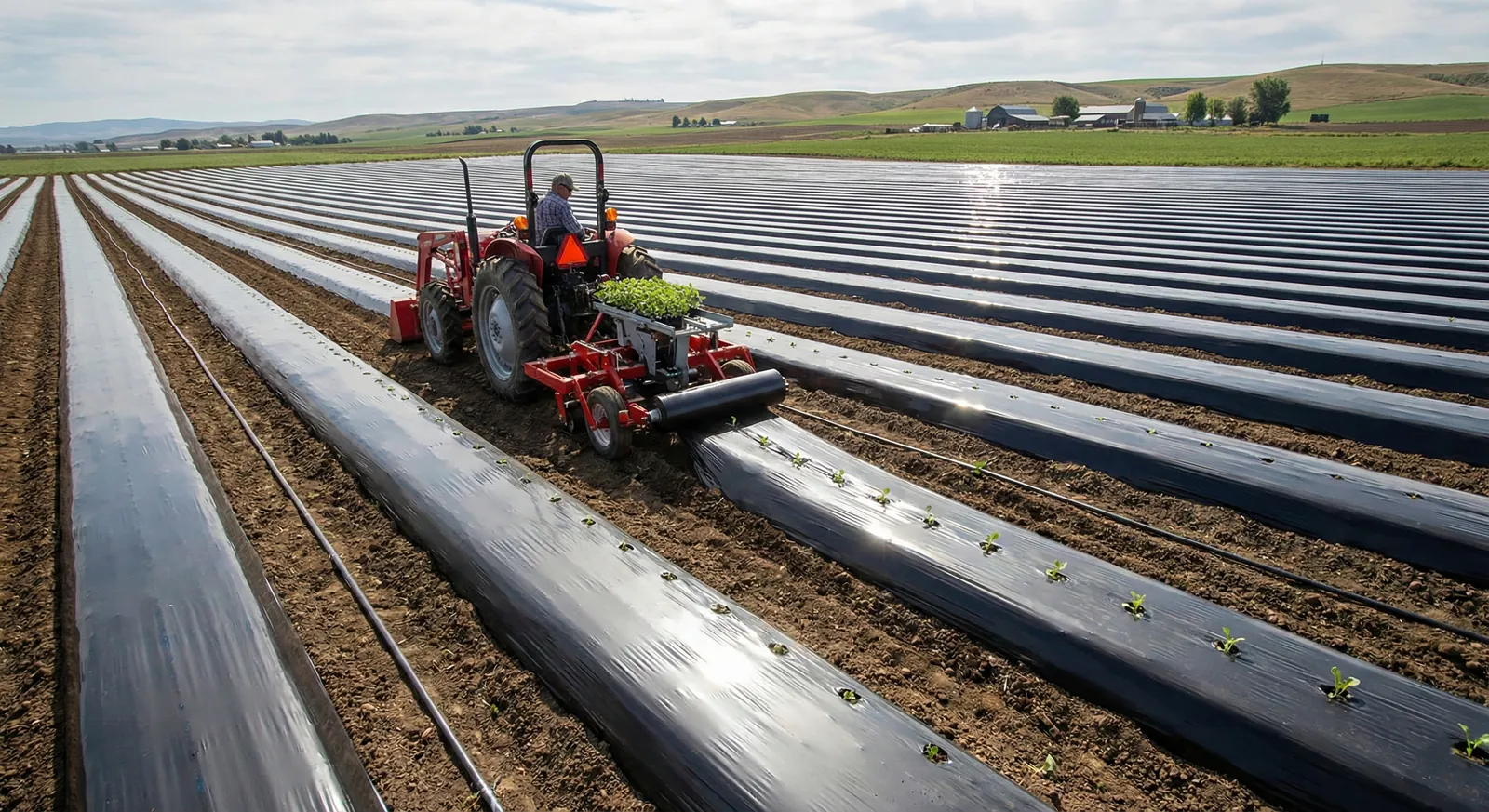
Australian vegetable districts — Bowen and Bundaberg in Queensland, the Murrumbidgee, Virginia on the Adelaide plains — plant against seasons that wait for no importer, and mulch film sits on the critical path of every row-crop planting. Distributors who lock annual volume with a manufacturer buy at programme rates; those who scramble in September pay spot prices and sometimes miss the planting window entirely. The wholesale mechanics below are what separate the two.
Container economics and roll formats
Mulch film rolls are dense but the air between cores adds up: a 40ft high cube carries a serious tonnage of 25 to 40 micron rolls, and per-kilo landed cost improves sharply at FCL versus LCL. Roll formats that serve Australian row crops: widths from 0.8 to 1.8 metres, black and silver-black colourways, UV packages sized to single-season or longer cycles. Mixed-width containers are normal — one FCL combining 1.0 metre silver-black, 1.2 metre black and 1.6 metre black serves three different crop programmes across a district. Transit from Mundra to Melbourne or Brisbane runs 25 to 35 days, which means a distributor targeting a September planting locks the order by June.
Pricing, duty and the Australia-specific layer
Wholesale pricing quotes per kilo or per roll FOB Mundra or CIF Melbourne, driven by micron, width and UV package. Duty on polyethylene film under HS 3920.10 runs low to nil on the general rate, with AI-ECTA preferential access available on many Indian lines when a certificate of origin is filed; 10% GST applies on landed value and is creditable for GST-registered buyers. DAFF biosecurity is procedural when the paperwork is right: clean bale packing, the packing declaration and container cleanliness statement ship with every consignment as standard, and photographs of the loaded container accompany the file so clearance never stalls.
End-of-season disposal: the question every AU buyer asks
Australia's agricultural plastic disposal reality is stricter than most markets, and sophisticated distributors ask before ordering: what happens to spent film? We supply lift-and-removal guidance with every order — film lifted whole in one pass, shaken clean of soil, and routed to regional agricultural plastic recycling programmes where they operate. Cleaner lifted film has real recycling value; soil-contaminated film has none, and that difference is worth explaining to grower customers because it changes how they manage the field at season end. Some Australian buyers now split orders between conventional PE mulch and biodegradable film for blocks where disposal is hardest — we supply both and can discuss the trade-offs honestly per crop.
Frequently Asked Questions
How much film fits a 40ft container?
Tonnage depends on micron and core design, but FCL loads run dramatically cheaper per kilo than LCL — send your roll list and we return exact container plans.
What duty will film attract into Australia?
HS 3920.10 polyethylene film runs low to nil on the general rate with AI-ECTA preferential treatment available on many Indian lines with a certificate of origin; 10% GST is creditable.
Black or silver-black for Queensland summers?
Silver-black through peak heat keeps root zones cooler; black suits cooler plantings and where soil warming helps early establishment.
Can we mix widths and colours per container?
Yes — most Australian distributors combine three or four roll specifications per FCL, colour-separated for warehouse picking.
Roll specifications are on the Mulch Film page. For UAE and Gulf technique read the Gulf mulch film guide, and for ground cover alternatives see the woven weed mat economics guide.