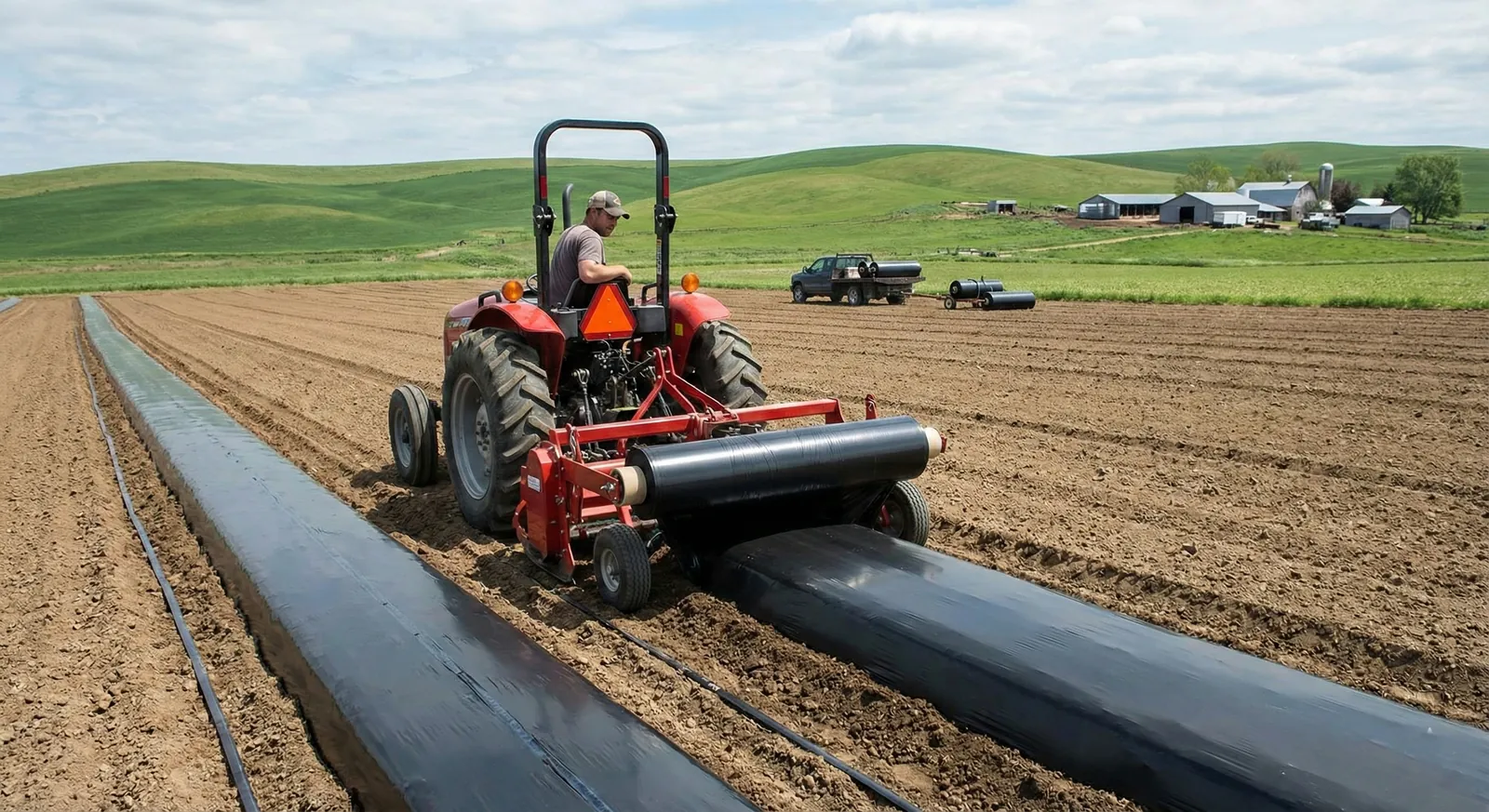
Saudi agriculture runs where water is the scarcest input on the farm, which is exactly why mulch film has moved from optional to standard across the vegetable sectors around Qassim, Al-Kharj and Tabuk. A laid mulch film blocks evaporation from the bed, keeps drip lines efficient and suppresses the weeds that would otherwise drink irrigation water for free. The difference between film that lasts a season and film that shatters in eight weeks is UV stabilisation quality — and under Saudi sun, that difference decides whether the investment pays.
What Saudi growers actually spec
The workhorse construction is 25 to 40 micron polyethylene in black or silver-on-black. Black mulch is the default for soil warming and weed suppression in winter rotations; silver-black reflects radiation through peak summer and keeps root zones cooler for pepper, tomato and melon plantings. Widths follow the bed former: 0.8 to 1.2 metre rolls for single drip rows, 1.6 to 1.8 metre for paired rows. UV packages are sized to the crop cycle — six months for most vegetable rotations, twelve for longer cycles — and every roll we ship to the Kingdom carries stabilisation validated for Gulf-level irradiation, not generic European conditions. Slot-perforated options run through mechanical planters; plain film suits hand-laid beds.
Where the film goes: crops and regions
Saudi vegetable production clusters around centre-pivot and open-field operations in Qassim and Al-Kharj, greenhouse and protected cropping in Tabuk and the coastal plains, and the date palm sector where mulch around basins cuts weed competition and water loss. The economics that convince growers: mulched beds cut irrigation frequency, which at Saudi water prices is the largest line item on most farms, and hand weeding between rows nearly disappears — a labour saving that matters in a market where farm labour is expensive and seasonal.
Import flow: India to the Kingdom
Film rolls ship baled and wrapped in covered containers from Mundra to Jeddah Islamic Port or King Abdulaziz Port Dammam in roughly 10 to 15 days. GCC customs applies the standard 5% CIF duty on polyethylene film under HS 3920.10 — confirm the exact line with your broker — and the document set is straightforward: invoice, packing list, bill of lading, certificate of origin. Most Saudi agricultural distributors order FCL with mixed widths per container, colour-separated by roll, so one container serves multiple crop programmes. SASO conformity questions rarely touch plain agricultural film, but material declarations ship with every order for the buyers whose customers ask.
Frequently Asked Questions
Which colour suits Saudi summer planting?
Silver-black through peak summer — the reflective face keeps crowns cooler and reduces transplant shock; black is preferred in cooler months for soil warming.
How many months of UV protection do I need?
Size the stabilisation to the crop cycle plus a buffer: six month film for most vegetable rotations, twelve month grades for long cycles under intense exposure.
What duty applies to mulch film imports?
The GCC standard 5% CIF duty applies on polyethylene film under HS 3920.10 — your clearing agent confirms the exact line and documentation.
Can one container mix widths and colours?
Yes — rolls ship colour- and width-separated per bale, and most Saudi distributors combine three or four specifications per FCL.
Thickness, widths and UV options are on the Mulch Film page. For desert UV strategy read the UAE and Gulf mulch guide, and for weed control under the same sun see UV stabilised ground cover for the Middle East.